

Digitize Today, Dominate Tomorrow
-
 Send Us Mail
 -
 Call 24/7 Hours
+91 9277 802030


Accelerating deployment velocity while maintaining software quality is the holy grail of modern fintech development. Our recent project achieved a 50% reduction in deployment time for a leading fintech client, enabling faster time-to-market and improved competitive advantage. This transformation streamlined their development pipeline and significantly enhanced their ability to respond to market changes and customer needs.
Fintech software development has become increasingly complex. According to industry research, projects typically take between one and nine months to complete, averaging about 4.5 months. More concerning is that software development projects often take about 30% more time than initially estimated. In today’s rapidly evolving financial technology landscape, this extended timeline can be the difference between market leadership and obsolescence.

The pressure to accelerate deployment is enormous, but the stakes in fintech are equally high. Financial applications demand absolute reliability, security, and compliance, creating a challenging balancing act between speed and quality.
Before implementing our solution, our client faced numerous challenges that are common across the fintech industry:

Our DevOps Consulting Services are focused on several key areas to dramatically improve deployment speed without compromising quality or security:

The most transformative change was the introduction of Infrastructure as Code (Iac) principles. By codifying the deployment of cloud resources, we achieved:
This approach eliminated manual errors and provided a repeatable, version-controlled deployment process.
We completely re-architected the deployment pipeline using DevOps best practices:
By leveraging Delta package deployments, we reduced deployment time by 60% compared to full deployments. This meant:
Our AI/ML Development team implemented automated testing, which:
While the 50% faster deployment was our headline achievement, the benefits extended further:
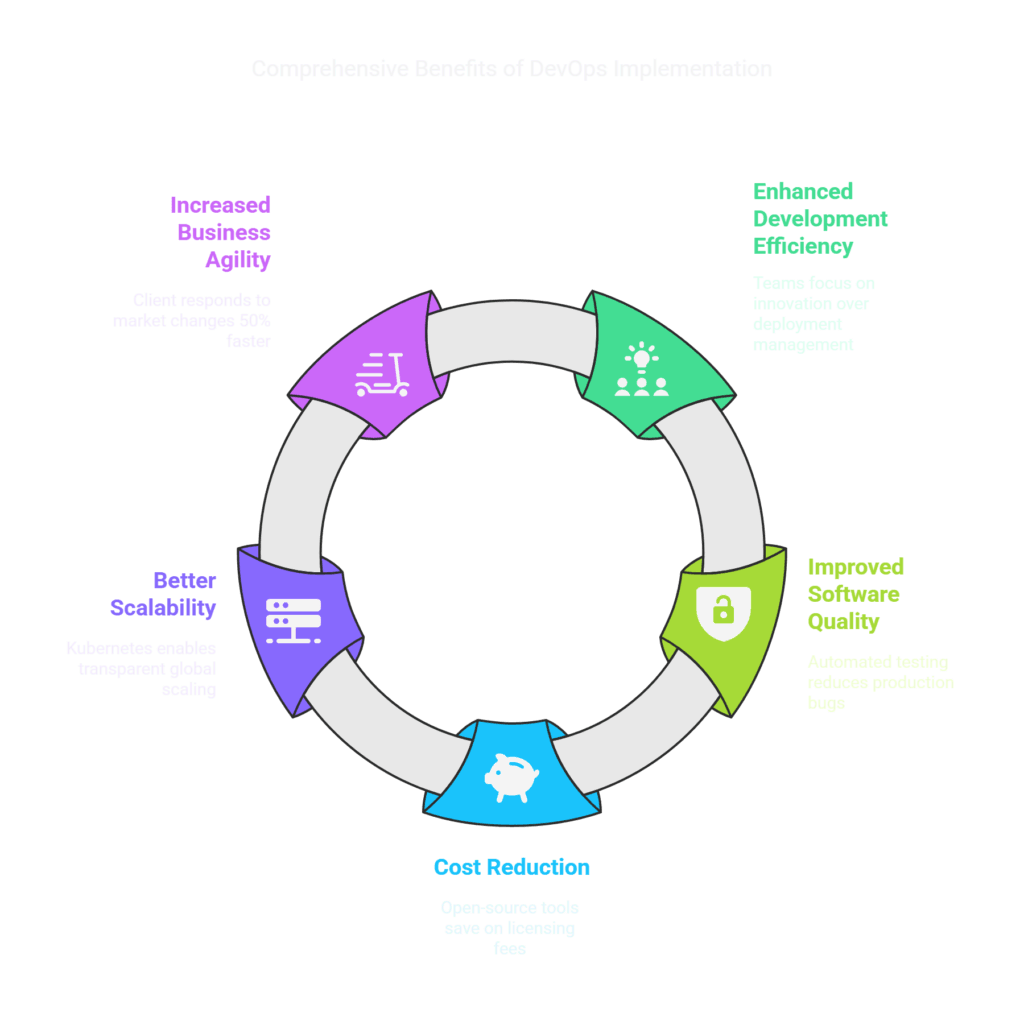
✅ Enhanced Development Efficiency – Teams now spend more time innovating rather than managing deployments.
✅ Improved Software Quality – Automated testing caught issues earlier, reducing bugs in production.
✅ Cost Reduction – Open-source tools saved thousands in licensing fees.
✅ Better Scalability – Kubernetes orchestration enabled transparent, global scaling.
✅ Increased Business Agility – The client now responds to market changes 50% faster.
For organisations looking to achieve similar results, we recommend our Digital Transformation Services with this roadmap:
In the fast-paced fintech industry, deployment speed is a critical differentiator. Our client’s 50% improvement has translated into faster time-to-market, better customer satisfaction, and accelerated innovation.
By leveraging Infrastructure as Code, CI/CD optimisation, delta deployments, and QA automation, we’ve set a foundation for sustained success in fintech.
For fintech companies struggling with slow deployments, modernising their pipeline isn’t just a technical upgrade—it’s a business imperative.
Ready to accelerate your fintech deployments?
👉 Explore our DevOps Consulting Services
👉 Learn more about our Fintech Solutions
Our AI will analyze your requirements and match you with vetted developers from our global talent pool efficiently and accurately
Drag and drop your PDF or DOCX here, or click to browse
Supported formats: PDF, DOCX (Max 10MB)
Takes ~15 seconds · No signup required
Our AI neural network is processing your requirements across millions of data points
Extracting key requirements and technical specifications
Identifying required technologies, frameworks, and expertise levels
Scanning our global database of pre-screened professionals
Applying proprietary algorithm to find best-fit matches
Ranking and selecting top candidates for your review
AI-powered matching based on your requirements
Unlock full roster with detailed profiles, interview recordings, and salary expectations.
Fill in your details to unlock full candidate profiles and connect with top talent.
 Mobile App Development
 AI & ML
 IT Consulting
 Website Development
 Digital Transformation
 Software Development
 DevOps & Cloud Solutions
 Product Design & Ideation
 Hire Nodejs Developer
 Hire ReactJs Developer
 Hire AngularJs Developer
 Hire Flutter Developer
 Hire VueJs Developer
 Hire Android Developer
 Hire iOS Developer
 Hire Python Developer
 Hire DotNet Developer
 Hire Laravel Developer
 Hire PHP Developer
 Hire CodeIgniter Developer
 Hire Golang Developer
 Hire ROR Developer
 Hire SalesForce Developer



Comments (0)
No comments yet.
Leave Your Comment: