

Digitize Today, Dominate Tomorrow
-
 Send Us Mail
-
 Call 24/7 Hours
+91 9277 802030

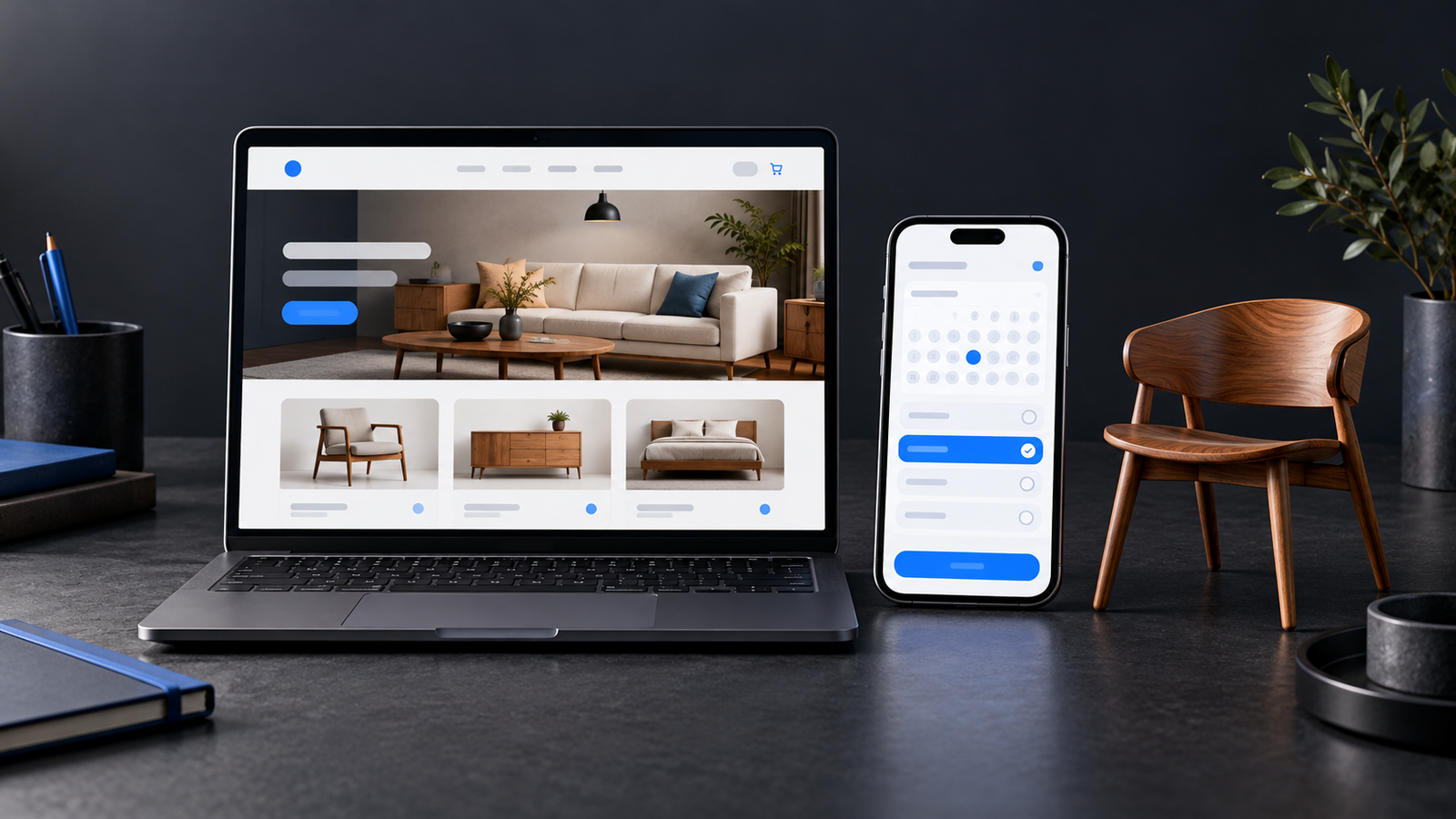
A customer hears about your furniture shop and searches for it on their phone. They want to see a few products, check your location and ask whether you deliver.
You could build an app for that. But would someone download it just to find your opening hours?
If you are choosing between a website or mobile app, start with the task your customer needs to finish. A useful first step is often much simpler than the product you initially imagined.
A website opens through a link in a browser, such as Chrome or Safari. Customers can reach it from a search result, a social post or a message without first installing your business’s app.
A mobile app is software people usually install on their phone. It can be designed around regular activities, such as checking deliveries, recording work or managing an account.
A website can also do more than display information. When people log in, make bookings or manage orders in a browser, they are using features often described as a web application.
That matters because “we need online booking” does not automatically mean “we need a downloadable app.” Booking can work on the web too.
Imagine that furniture shop is yours. Most new visitors want to browse your range, understand the price level and arrange a showroom visit.
A clear website could handle those needs with product photos, useful descriptions, delivery information and an enquiry form. Making it comfortable to use on a phone would be part of that job.
Now picture a different business: a company whose delivery drivers need to scan parcels and record delivery attempts throughout the day. That repeated working routine gives the team a stronger reason to investigate a dedicated app.
The important difference is how people use the service. The number of smartphones in your market does not settle the decision.
A website is worth considering first when people mainly need to discover your business, understand your offer and contact you. It also gives you a link you can share wherever a customer asks for more information.
Think about a local consultancy. Its next useful improvement might be a page that clearly explains its services and lets visitors request a meeting.
An app would add another step before that first conversation. Unless it offers an ongoing service customers value, there may be little reason for them to keep it installed.
Before commissioning something new, try your current website on a phone. If visitors cannot read the service details or complete the enquiry form, fixing that experience may address the immediate problem.
An app becomes more interesting when people return regularly and need a convenient way to complete a specific job. Examples include staff carrying out daily field inspections or customers managing a service they use repeatedly.
Device features can matter too. A project may need scanning, location information or work that continues when connectivity drops.
Write down the exact behaviour you need and ask a developer to demonstrate it on the devices your users actually have. Installing an app does not automatically make every feature work offline.
Also consider the invitation you are making to customers. “Download our app” is a bigger request than “open this link,” so be clear about the value they receive in return.
You may hear a developer mention a progressive web app, or PWA. This uses web technology and can offer app-like features, including installation and, when built for it, some offline behaviour.
It can be an option when you want access through a web link alongside selected app features. Support and behaviour vary across browsers and devices, so the details need checking.
Mozilla’s introduction to progressive web apps explains how this overlaps with traditional websites and apps. You do not need to choose the technology yourself; you need to explain the customer task clearly enough for your team to compare the options.
The first development quote is only part of the commitment. Your product will need someone to update information, respond to problems and check that important features still work.
Ask each potential partner to explain what their proposal includes after launch. For an app, that conversation should cover supported devices and operating-system updates; for a website, it should cover the browser experience and the services it depends on.
A simple website and a complex web application are very different projects. Broad claims that one platform is always cheaper will not tell you what your business needs.
For the factors behind an app estimate, see our guide to mobile app development costs in India.
Before your first development call, finish this sentence: “Our customers need to ___, and today they struggle because ___.”
Then explain how often that happens, which devices people use and what a successful result would look like. Those details give a developer something useful to assess.
For the furniture shop, that might lead to a better mobile website. For the delivery team, it might lead to an app trial with a small group of drivers.
You can add another channel later. For now, build the one that makes the customer’s next step easier.
Our AI will analyze your requirements and match you with vetted developers from our global talent pool efficiently and accurately
Drag and drop your PDF or DOCX here, or click to browse
Supported formats: PDF, DOCX (Max 10MB)
Takes ~15 seconds · No signup required
Our AI neural network is processing your requirements across millions of data points
Extracting key requirements and technical specifications
Identifying required technologies, frameworks, and expertise levels
Scanning our global database of pre-screened professionals
Applying proprietary algorithm to find best-fit matches
Ranking and selecting top candidates for your review
AI-powered matching based on your requirements
Unlock full roster with detailed profiles, interview recordings, and salary expectations.
Fill in your details to unlock full candidate profiles and connect with top talent.
 Mobile App Development
 AI & ML
 IT Consulting
 Website Development
 Digital Transformation
 Software Development
 DevOps & Cloud Solutions
 Product Design & Ideation

 Hire Nodejs Developer
 Hire ReactJs Developer
 Hire AngularJs Developer
 Hire Flutter Developer
 Hire VueJs Developer
 Hire Android Developer
 Hire iOS Developer
 Hire Python Developer
 Hire DotNet Developer
 Hire Laravel Developer
 Hire PHP Developer
 Hire CodeIgniter Developer
 Hire Golang Developer
 Hire ROR Developer
 Hire SalesForce Developer


Comments (0)
No comments yet.
Leave Your Comment: