
Tech Journal | AppZime Technologies

Website Maintenance Cost in India 2025

As we move into 2025, website maintenance has evolved from a simple technical necessity to a strategic business investment. With increasing cyber threats, UX expectations, and technology advancements, professional website maintenance has become essential for businesses of all sizes in India.

The projected website maintenance costs in India for 2025 range from ₹2,500 to ₹30,000 per month, depending on website complexity, industry requirements, and the level of service needed.

Comprehensive Maintenance Cost Breakdown

Core Maintenance Services

Maintenance ServiceDescriptionMonthly Cost Range (2025)
Security Updates & MonitoringCritical security patches, malware scanning, firewall management₹1,500-₹7,000
Performance OptimizationSpeed improvements, caching configuration, image optimization₹1,000-₹5,000
Content UpdatesText changes, image updates, new page creation₹2,000-₹8,000
Technical SupportIssue resolution, browser compatibility fixes₹1,500-₹6,000
Backup ManagementRegular automated backups with secure storage₹800-₹3,000
Uptime Monitoring24/7 website availability checking with alerts₹500-₹2,500

Additional Specialized Services

ServiceDescriptionCost Range (2025)
E-commerce MaintenanceProduct updates, payment gateway maintenance, inventory system managementAdditional ₹3,000-₹10,000/month
SEO MaintenanceKeyword monitoring, performance tracking, content optimization₹5,000-₹15,000/month
Advanced SecurityAI-powered threat detection, enhanced DDoS protection, security audits₹3,000-₹12,000/month
Third-party Integration ManagementAPI updates, CRM/ERP connections, payment system maintenance₹2,000-₹8,000/month

Monthly Maintenance Packages and Pricing

Most maintenance providers in India offer tiered packages to accommodate different business needs and budgets:

Essential Maintenance Package

₹2,500-₹5,000/month

  • Core security updates and patches
  • Basic performance monitoring
  • Monthly backups
  • Limited content updates (1-2 hours/month)
  • Email support
  • Best for: Small business websites, personal blogs, portfolios

Business Maintenance Package

₹5,000-₹12,000/month

  • Everything in Essential package
  • Weekly security scans and monitoring
  • Regular performance optimization
  • Weekly backups
  • Extended content updates (3-5 hours/month)
  • Priority email and phone support
  • Basic SEO monitoring
  • Best for: Medium-sized business websites, small e-commerce stores

Premium Maintenance Package

₹12,000-₹25,000/month

  • Everything in Business package
  • Daily security monitoring with advanced threat protection
  • Proactive performance enhancements
  • Daily automated backups
  • Comprehensive content management (10+ hours/month)
  • 24/7 emergency support
  • Advanced SEO maintenance and reporting
  • Third-party integration management
  • Best for: Large business websites, established e-commerce platforms

Enterprise Maintenance Package

₹25,000-₹50,000+/month

  • Custom maintenance solutions
  • Dedicated support team
  • Advanced security protocols with regular penetration testing
  • Comprehensive technical audits

Factors Affecting Maintenance Costs

Understanding what influences website maintenance costs in 2025 will help you budget more effectively:

1. Website Size and Complexity

In 2025, website complexity has become a more significant cost factor as sites incorporate more advanced features:

Website TypeTypical Maintenance Cost (2025)
Small (5-10 pages)₹2,500-₹5,000/month
Medium (10-30 pages)₹5,000-₹12,000/month
Large (30-100 pages)₹12,000-₹25,000/month
Enterprise (100+ pages)₹25,000-₹50,000+/month

2. Technology Stack

The technology powering your website significantly impacts maintenance requirements and costs:

  • WordPress Maintenance: ₹3,000-₹15,000/month
    • Most economical option with abundant support resources
    • Regular updates required for themes and plugins
  • Custom CMS Maintenance: ₹8,000-₹30,000/month
    • Higher costs due to specialized development requirements
    • Less frequent but more complex updates
  • E-commerce Platform Maintenance: ₹5,000-₹25,000/month
    • Additional costs for payment gateway maintenance
    • Higher security requirements for transaction protection
    • Inventory and product catalog management
  • Progressive Web App (PWA) Maintenance: ₹7,000-₹30,000/month
    • More complex architecture requiring specialized expertise
    • Enhanced performance monitoring requirements

3. Security Requirements

By 2025, cybersecurity has become the most critical maintenance consideration:

  • Basic Security Package: ₹1,500-₹5,000/month
    • Standard malware scanning
    • Regular security updates
    • Basic firewall configuration
  • Advanced Security Package: ₹5,000-₹15,000/month
    • AI-powered threat detection and prevention
    • Regular security audits
    • Enhanced DDoS protection
    • Compliance monitoring (GDPR, PCI-DSS)
  • Enterprise Security Package: ₹15,000-₹30,000+/month
    • 24/7 security monitoring
    • Advanced encryption implementation
    • Regular penetration testing
    • Comprehensive incident response planning

4. Update Frequency

How often you need updates directly impacts maintenance costs:

  • Monthly Updates: ₹2,500-₹8,000/month
  • Weekly Updates: ₹5,000-₹15,000/month
  • Daily/On-demand Updates: ₹12,000-₹30,000+/month

Cost-Effective Maintenance Strategies

As website maintenance costs continue to rise in 2025, implementing these strategies can help optimize your budget:

1. Tiered Maintenance Approach

Implement a strategic maintenance schedule that prioritizes critical elements:

  • Critical Components: Security, backups, core functionality (monthly attention)
  • Important Elements: Performance optimization, content updates (quarterly attention)
  • Nice-to-have Components: Minor design tweaks, feature enhancements (bi-annual attention)

2. Preventative Maintenance Investment

Investing in preventative maintenance has proven more cost-effective than emergency fixes:

Maintenance ApproachAverage Annual Cost (2025)Downtime RiskBusiness Impact
Reactive Maintenance₹50,000-₹2,00,000+HighSignificant revenue loss potential
Preventative Maintenance₹30,000-₹1,20,000LowMinimal disruption

3. Bundled Service Packages

Many agencies in 2025 offer cost-effective bundled maintenance packages when combined with other digital services:

  • Website maintenance + SEO: 15-25% savings
  • Website maintenance + content marketing: 10-20% savings
  • Website maintenance + social media management: 15-30% savings

Selecting the Right Maintenance Provider

Freelance Maintenance Professionals

  • Cost Range: ₹2,000-₹8,000/month
  • Best For: Small businesses with basic websites
  • Pros: Lower costs, direct communication
  • Cons: Limited availability, potentially restricted skill set, risky continuity

Boutique Digital Agencies

  • Cost Range: ₹5,000-₹20,000/month
  • Best For: Growing businesses with moderate complexity websites
  • Pros: Balanced cost-quality ratio, personalized service, broader skill coverage
  • Cons: May have capacity limitations during peak periods

Full-Service Digital Agencies

  • Cost Range: ₹15,000-₹50,000+/month
  • Best For: Established businesses with complex websites or e-commerce platforms
  • Pros: Comprehensive service offerings, specialized expertise, guaranteed SLAs
  • Cons: Higher cost, potentially less personalized attention

Automated Maintenance Tools

  • Cost Range: ₹1,000-₹5,000/month
  • Best For: Supplementing human maintenance efforts
  • Pros: Cost-effective for basic monitoring, consistent performance
  • Cons: Limited problem-solving capabilities, requires human oversight

By 2025, the most effective website maintenance approach typically involves a hybrid model combining professional services with automated tools for optimal cost efficiency.

Industry-Specific Maintenance Considerations

Different industries face unique maintenance challenges and requirements in 2025:

E-commerce Website Maintenance

Average Cost: ₹8,000-₹30,000/month

E-commerce maintenance costs have increased due to:

  • Advanced payment security protocols (PCI DSS 4.0 compliance)
  • AI-powered inventory management systems
  • Enhanced customer experience features
  • Personalization engine maintenance
  • Real-time analytics monitoring

Healthcare Website Maintenance

Average Cost: ₹10,000-₹25,000/month

Healthcare websites require specialized maintenance for:

  • Enhanced privacy compliance (HIPAA-equivalent standards in India)
  • Secure patient portal maintenance
  • Telemedicine integration maintenance
  • Medical data encryption and security
  • Appointment scheduling system upkeep

Financial Services Website Maintenance

Average Cost: ₹12,000-₹40,000/month

Financial websites demand premium maintenance due to:

  • Stringent security requirements with advanced encryption
  • Real-time transaction monitoring systems
  • Regulatory compliance management
  • API connections to financial data services
  • Fraud detection system integration

The Future of Website Maintenance in India

As we progress through 2025, several trends are reshaping website maintenance costs and approaches:

AI-Powered Maintenance

Artificial intelligence is revolutionizing routine maintenance tasks:

  • Automated security vulnerability detection
  • Predictive performance optimization
  • Content quality monitoring
  • User experience optimization
  • Cost impact: Initial investment increasing but long-term cost reduction of 15-30%

Blockchain Security Integration

Blockchain technology is becoming more mainstream for website security:

  • Distributed database security
  • Enhanced authentication systems
  • Immutable audit trails for security events
  • Cost impact: Increasing security costs by 20-40% but reducing breach risks significantly

Sustainability Optimization

Website energy efficiency has become a maintenance priority:

  • Server efficiency optimization
  • Code efficiency improvements
  • Sustainable hosting monitoring
  • Carbon footprint reporting
  • Cost impact: Additional 5-15% maintenance cost offset by improved brand perception

FAQs

What is included in basic website maintenance in 2025?

Basic website maintenance in 2025 typically includes security updates, performance monitoring, regular backups, minor content updates, uptime monitoring, and email support. Prices range from ₹2,500-₹5,000 per month.

How has website maintenance changed between 2023 and 2025?

The most significant changes include increased security requirements, greater focus on performance optimization, enhanced user experience maintenance, AI integration in maintenance processes, and stricter compliance monitoring. These advancements have increased costs by approximately 15-30%.

Is it cheaper to handle website maintenance in-house in 2025?

While in-house maintenance provides greater control, it remains more expensive than outsourcing for most businesses due to the specialized expertise required. The cost gap has widened as maintenance complexity has increased, making outsourcing more cost-effective than in previous years.

How often should websites be maintained in 2025?

Critical security maintenance should be performed weekly, with performance optimization monthly, content updates as needed, and comprehensive technical audits quarterly. This schedule has intensified from previous years due to more frequent security threats and technology changes.

What impacts e-commerce website maintenance costs the most in 2025?

The biggest cost factors for e-commerce maintenance in 2025 are payment security compliance, inventory system maintenance, personalization engine upkeep, and integration with evolving marketplace platforms. These requirements have become more complex as e-commerce technology has advanced.

How do mobile optimization requirements affect maintenance costs?

With mobile traffic exceeding 75% for most websites in 2025, mobile optimization has become a critical maintenance component. This includes progressive web app maintenance, responsive design updates, and mobile performance optimization, adding approximately 15-20% to baseline maintenance costs.

Are there any government regulations affecting website maintenance costs in 2025?

Yes, the Digital Personal Data Protection Act implementation and cybersecurity compliance requirements for certain industries have increased maintenance costs by requiring regular security audits, enhanced user data management, and formal compliance documentation.

Cost-Benefit Analysis of Professional Website Maintenance

When evaluating website maintenance costs in 2025, consider the return on investment rather than viewing it as a pure expense:

Maintenance InvestmentPotential Business Impact
₹30,000-₹60,000/year99.9% uptime (vs. 97% without maintenance)<br>- 30-40% faster page load times<br>- 15-25% higher conversion rates<br>- 40-60% lower security breach risk
₹60,000-₹1,20,000/yearEverything above plus:<br>- Enhanced user experience<br>- Improved search engine rankings<br>- 25-35% increase in organic traffic<br>- 80-90% lower security breach risk
₹1,20,000-₹3,00,000+/yearEverything above plus:<br>- Custom feature development<br>- Advanced analytics and optimization<br>- 99.99% uptime guarantee<br>- Dedicated support team<br>- Near-zero security breach risk

Essential Website Maintenance Checklist for 2025

To ensure comprehensive website maintenance, whether performed in-house or outsourced, this checklist covers critical elements required in 2025:

Weekly Maintenance Tasks

  • Security updates installation
  • Malware scanning
  • Website backup verification
  • Uptime monitoring
  • Error log review
  • Form functionality testing

Monthly Maintenance Tasks

  • Performance optimization
  • Mobile responsiveness testing
  • Broken link checking
  • Third-party integration testing
  • SEO performance review
  • User experience evaluation

Quarterly Maintenance Tasks

  • Comprehensive security audit
  • Database optimization
  • Content relevance review
  • Compliance verification
  • Technology stack evaluation
  • Competitor analysis

Conclusion: Strategic Investment for Digital Success

Website maintenance costs in India have evolved from a basic technical expense to a strategic business investment in 2025. While costs have increased compared to previous years, the value delivered through enhanced security, performance, and user experience has increased proportionally.

For businesses looking to optimize their maintenance budget while ensuring website effectiveness, we recommend:

  1. Start with a professional website audit to identify critical maintenance needs
  2. Select the appropriate maintenance tier based on your website complexity and business goals
  3. Consider bundled service packages for cost efficiency
  4. Implement a hybrid maintenance model combining automated tools with professional services
  5. Regularly review maintenance performance against business objectives

By viewing website maintenance as a strategic investment rather than an overhead cost, businesses can ensure their digital presence remains secure, effective, and competitive in 2025 and beyond.


Need expert website maintenance services? Contact Appzime for a customized maintenance plan tailored to your business needs.

Learn more about our web development services

IT Staff Augmentation: Scale Your Tech Team Effectively Without the Hassle

In today’s fast-paced tech world, businesses face a common challenge: how to scale IT teams quickly without the traditional headaches of full-time hiring. IT staff augmentation services offer a flexible solution that many companies are turning to. This comprehensive guide explains everything you need to know about effectively scaling your tech team through IT talent augmentation.

What Is IT Staff Augmentation?

IT staff augmentation is a flexible outsourcing strategy where businesses hire tech talent on a temporary basis to supplement their existing team. Unlike traditional outsourcing where entire projects are handed off, tech team augmentation integrates external professionals directly into your team structure.

IT staff augmentation is when you temporarily hire external tech professionals to work alongside your existing team, giving you flexible access to specialized skills without permanent hiring commitments.

Key Benefits of IT Staff Augmentation

it staff augmentation benefits 1

1. Cost Efficiency

Cost-effective IT staffing eliminates expenses associated with full-time employees like benefits, training, and office space. You pay only for the time and skills you need.

2. Access to Specialized Talent

Gain immediate access to tech talent on demand with niche skills that might be rare in your local market or too expensive to hire permanently.

3. Scalability

Easily scale your development team up or down based on project demands without the emotional and financial costs of hiring and layoffs.

4. Faster Time-to-Market

Skip the lengthy recruitment process and bring in pre-vetted IT professionals to start contributing almost immediately.

5. Reduced Administrative Burden

The IT staffing provider typically handles paperwork, payroll, and compliance issues.

Common IT Staff Augmentation Models

ModelBest ForKey AdvantagePotential Drawback
Project-BasedShort-term initiatives with clear endpointsDefined scope and timelineLess integration with core team
Role-BasedFilling specific positions temporarilyDirect replacement for missing team membersMay require more onboarding
Team-BasedScaling entire IT functions quicklyCohesive group that already works well togetherHigher cost than individual hires
OffshoreCost-sensitive projectsSignificant cost savingsTime zone and communication challenges
NearshoreBalance of cost and collaborationSimilar time zones, easier communicationHigher cost than offshore
OnsiteHigh-security or high-collaboration needsMaximum integration with your teamHighest cost option

When to Consider IT Staff Augmentation

Remote IT staff augmentation works particularly well in these scenarios:

  1. Project Surges: When temporary increases in workload don’t justify permanent hires
  2. Skill Gaps: When specific tech expertise is needed but not available in-house
  3. Time Constraints: When hiring timelines don’t align with project deadlines
  4. Budget Limitations: When full-time salaries aren’t feasible
  5. Technology Transitions: When moving to new platforms or technologies
  6. Geographic Expansion: When entering new markets requiring local knowledge

How to Implement Staff Augmentation Successfully

Step 1: Assess Your Needs

Before approaching IT staffing solutions providers, clearly define:

  • Skills and experience levels required
  • Project scope and timeline
  • Number of professionals needed
  • Budget constraints
  • Required working hours and availability

Step 2: Choose the Right Provider

Look for top IT staff augmentation companies that:

  • Specialize in your industry or technology stack
  • Have a rigorous vetting process
  • Offer transparent pricing
  • Provide clear communication channels
  • Have positive testimonials and case studies

Step 3: Establish Clear Processes

Set up:

  • Onboarding procedures
  • Communication protocols
  • Performance expectations
  • Quality standards
  • Knowledge transfer mechanisms

Step 4: Integrate Augmented Staff Effectively

For seamless integration of extended development teams:

  • Include augmented staff in team meetings and communications
  • Provide access to necessary tools and resources
  • Assign internal points of contact
  • Clarify reporting structures
  • Share company culture and values

Comparing Traditional Hiring vs. Staff Augmentation

FactorTraditional HiringIT Staff Augmentation
Time to Onboard3-6 months1-3 weeks
Cost StructureSalary + benefits + overheadHourly or project-based rate
CommitmentLong-termFlexible, as needed
Recruitment EffortHigh (job posting, interviews, negotiations)Minimal (provider handles selection)
RiskHigh (if new hire doesn’t work out)Low (easy replacement if needed)
Management OverheadHighModerate
Access to Specialized SkillsLimited to local marketGlobal talent pool
Scaling AbilitySlow and costlyQuick and flexible

Industries Benefiting Most from IT Staff Augmentation

  1. Financial Services: For compliance-related tech projects and security implementations
  2. Healthcare: For EMR implementations and telehealth solutions
  3. E-commerce: For seasonal scaling and platform migrations
  4. Software Development: For accelerating product development cycles
  5. Manufacturing: For digital transformation initiatives
  6. Startups: For rapid scaling without long-term commitments
IT Staff Augmentation

Real-World Success Metrics

Companies implementing effective IT resource augmentation strategies report:

  • 40-60% cost savings compared to traditional hiring
  • 70% faster project kickoff times
  • 25-30% improvement in time-to-market
  • 35% reduction in project management overhead
  • 45% better access to specialized skills

Common Challenges and Solutions

Challenge 1: Cultural Integration

Solution: Include augmented staff in team-building activities, regular meetings, and company communications.

Challenge 2: Knowledge Transfer

Solution: Implement documentation standards and scheduled knowledge-sharing sessions.

Challenge 3: Quality Control

Solution: Establish clear KPIs and regular performance reviews.

Challenge 4: Communication Barriers

Solution: Use collaborative tools and establish regular check-ins across time zones.

Challenge 5: Security Concerns

Solution: Implement proper access controls and confidentiality agreements.

Best Practices for Managing Augmented Teams

  1. Set clear expectations: Define deliverables, timelines, and quality standards upfront.
  2. Communicate effectively: Schedule regular check-ins and use collaboration tools.
  3. Provide necessary context: Share business goals and project background.
  4. Offer feedback: Provide regular, constructive feedback.
  5. Plan for knowledge transfer: Document processes and decisions for future reference.
  6. Build relationships: Treat augmented IT staff as valued team members, not just resources.
  7. Measure performance: Track productivity and quality metrics.

How to Choose Between Different Augmentation Models

Consider these factors when deciding between offshore IT staffing, nearshore, or onsite models:

FactorOffshoreNearshoreOnsite
CostLowestModerateHighest
Time Zone OverlapMinimalSignificantComplete
Communication EaseChallengingModerateEasiest
Cultural AlignmentVariedBetterStrongest
Travel RequirementsDifficultOccasionalNone
Security ConsiderationsHighest concernModerate concernLowest concern
Best ForCost-sensitive, well-defined workBalance of cost and collaborationSecurity-sensitive, highly collaborative work

Future Trends in IT Staff Augmentation

  1. AI-Powered Matching: Algorithms connecting companies with the right talent based on specific project needs
  2. Hybrid Models: Combining remote and onsite work for optimal productivity
  3. Specialized Platforms: Industry-specific talent marketplaces
  4. Skills-Based Hiring: Focus on demonstrated abilities rather than credentials
  5. Continuous Learning Partnerships: IT augmentation companies offering ongoing training

Measuring ROI on Staff Augmentation

Track these metrics to measure your IT staff augmentation success:

  • Project completion time compared to baseline estimates
  • Cost savings versus traditional hiring
  • Quality metrics (bug rates, customer satisfaction)
  • Knowledge transfer effectiveness
  • Team productivity improvements
  • Time-to-market acceleration

Case Study: Financial Tech Company Scales Development Team

A mid-sized fintech company needed to accelerate development of their mobile banking platform but couldn’t find local talent with the specific skills required.

Solution: They engaged an IT staff augmentation provider to add three senior React Native developers and a QA specialist to their team for six months.

Results:

  • Product launched 40% faster than projected
  • Development costs reduced by 35% compared to local hiring
  • Existing team gained valuable knowledge in React Native development
  • Company avoided long-term hiring commitments while still meeting market demands

Ready to Scale Your Team Without the Hassle? Appzime Technologies Can Help!

Are you struggling to find the right tech talent for your projects? Appzime Technologies specializes in providing high-quality IT staff augmentation solutions tailored to your specific needs.

Why Choose Appzime Technologies for Your IT Staffing Needs:

  • Pre-vetted talent pool of skilled developers, engineers, and IT specialists
  • Rapid deployment – get the right people working on your projects within days, not months
  • Flexible engagement models to suit your budget and project requirements
  • Seamless integration with your existing team and processes
  • Industry expertise across multiple technology stacks and business domains

Don’t let talent gaps slow down your business growth. Our IT staff augmentation services can help you scale quickly, efficiently, and cost-effectively.

[Take the Next Step] Visit Appzime today to learn how Appzime Technologies can transform your IT staffing strategy and accelerate your business goals.

Or contact us for a free consultation about your specific staffing needs.

“With Appzime’s staff augmentation services, we were able to scale our development team by 40% in just two weeks, helping us meet our critical project deadline that otherwise would have been impossible.”

Frequently Asked Questions

What’s the difference between staff augmentation and project outsourcing?

Answer: IT staff augmentation integrates external professionals into your existing team and management structure. Project outsourcing hands off entire projects to an external team that manages themselves and delivers a completed product.

How quickly can augmented staff begin working?

Answer: Typically, augmented IT professionals can begin within 1-3 weeks, compared to the 3-6 months often required for traditional hiring and onboarding.

Is staff augmentation only for large companies?

Answer: No, businesses of all sizes benefit from IT talent augmentation. Small companies often use it to access enterprise-level talent they couldn’t otherwise afford, while larger organizations value the flexibility and specialized skills.

How do we maintain security with augmented staff?

Answer: Implement proper NDAs, access controls, secure communication channels, and clearly defined security protocols. Reputable providers like Appzime Technologies have established security practices and vetting procedures.

What happens when the contract ends?

Answer: You can extend the contract, transition to a permanent hire if there’s mutual interest, or complete knowledge transfer to ensure continuity after the engagement ends.

How do we ensure quality with augmented staff?

Answer: Set clear expectations and deliverables, establish regular code reviews and quality checks, and maintain open communication. Choose trusted IT staffing providers with rigorous talent vetting processes.

Conclusion: Making Staff Augmentation Work for Your Business

IT staff augmentation offers a powerful way to scale your technical capabilities without the traditional hassles of recruitment, training, and long-term commitments. By carefully assessing your needs, choosing the right partner, and implementing thoughtful integration practices, you can achieve significant cost savings while accelerating your technology initiatives.

The most successful organizations approach tech talent augmentation as a strategic tool rather than just a stopgap measure. They build lasting relationships with quality providers and create internal processes that make integration of external talent seamless and productive.

As the technology landscape continues to evolve at a rapid pace, the ability to flexibly scale your technical capabilities will remain a crucial competitive advantage. IT resource augmentation provides that flexibility while minimizing risk and maximizing your access to global talent pools.

Consider starting with a small engagement to test the waters, and you may discover that IT staff augmentation becomes an essential part of your overall talent strategy.

Remember, the right staffing partner can make all the difference. Visit Appzime Technologies to start scaling your team effectively today!

Website Development Cost in India: Complete 2025 Pricing Guide

Website development costs in India range from ₹10,000 for basic sites to ₹5,00,000+ for complex enterprise solutions. Your final price depends on your specific business requirements, chosen features, and development approach. This comprehensive guide breaks down all pricing factors to help you budget effectively and maximize your online investment.

Understanding the Factors Behind Website Development Pricing in India

The cost of creating a website in India varies significantly based on several key factors. A simple business website might cost between ₹15,000 and ₹30,000, while more sophisticated platforms can reach ₹1,00,000 or more. Unlike global markets where similar services often cost triple these amounts, India offers excellent value without compromising quality.

Website development pricing reflects not just the visible design elements, but also the underlying technology, functionality, and expertise involved. In 2025, businesses are investing more in their digital presence as online commerce continues to grow at 35% annually in India. This increased demand has created a diverse market where pricing depends on project complexity, developer expertise, and business requirements.

When planning your website budget, remember that development is just the beginning. Ongoing maintenance, updates, and marketing efforts represent additional investments that contribute to your site’s long-term success. A website that generates leads or sales often delivers returns many times its initial cost over its lifetime.

Website Types and Their Cost Ranges in the Indian Market

Different website categories have distinct price ranges based on their complexity and required features. Understanding these categories helps you set realistic budget expectations for your project.

Informational Websites (₹10,000 – ₹25,000)

Basic websites that primarily provide information about your business cost between ₹10,000 and ₹25,000. These typically include 5-8 pages covering your services, an about section, and contact information. At this price point, you can expect a professional design using templates or themes, mobile responsiveness, and basic SEO setup.

These starter websites work well for small local businesses that need an online presence but don’t require complex functionality. They provide essential information to potential customers and help establish business credibility. While limited in features, they offer excellent value for businesses just beginning their digital journey.

Small Business Websites (₹25,000 – ₹75,000)

More comprehensive business websites with 10-20 pages and additional functionality fall in the ₹25,000 to ₹75,000 range. These sites typically include custom design elements, content management systems, blog sections, newsletter integration, and more sophisticated contact forms or booking systems.

This mid-range option provides a good balance between cost and functionality for growing businesses. The higher investment delivers better user experience, more content flexibility, and features that support business growth. These websites often include custom graphics and optimized page layouts that reflect your brand identity more accurately.

E-commerce Websites (₹75,000 – ₹3,50,000)

Online stores require more complex development work and additional features. E-commerce website development in India typically costs between ₹75,000 and ₹3,50,000, depending on the number of products, payment options, and specialized requirements.

The wide price range reflects significant differences in platform sophistication. A basic online store with 50-100 products might cost ₹75,000 to ₹1,50,000, while larger stores with thousands of products, multiple payment gateways, and custom features can reach ₹3,50,000 or more. These websites require careful planning to ensure security, performance, and user-friendly shopping experiences.

Custom Web Applications (₹2,00,000 – ₹5,00,000+)

Custom web applications with specialized functionality start from ₹2,00,000 and can exceed ₹5,00,000 depending on complexity. These projects involve custom database structures, advanced user management, specialized calculators or tools, and often integration with other business systems.

These sophisticated platforms require significant development expertise and planning. They’re ideal for businesses with unique processes that can’t be addressed with standard solutions. While expensive, custom applications can deliver substantial business value by automating processes, improving customer experiences, or enabling new service models.

Choosing the Right Development Approach for Your Budget

Different development approaches offer various combinations of cost, customization, and maintenance requirements. Selecting the right approach for your project can help optimize your investment.

Template-Based Development (₹15,000 – ₹75,000)

Using pre-designed templates with platforms like WordPress, Wix, or Shopify offers the most economical approach. Template-based websites typically cost between ₹15,000 and ₹75,000 depending on customization requirements and added functionality.

This approach works well for businesses with standard needs and limited budgets. Modern templates provide professional designs and mobile responsiveness without the expense of custom development. While less unique than custom solutions, template sites can be customized with your branding, content, and specific feature configurations.

Semi-Custom Development (₹75,000 – ₹2,00,000)

Semi-custom development combines templates or themes with significant customization and additional functionality. This approach typically costs between ₹75,000 and ₹2,00,000 depending on the extent of customization and added features.

This middle-ground option provides more uniqueness and tailored functionality without the full expense of custom development. Developers start with existing platforms but modify designs, add custom features, and integrate specialized functionality to meet your specific requirements. This approach balances cost, time, and customization effectively for many growing businesses.

Fully Custom Development (₹2,00,000 – ₹5,00,000+)

Custom development involves building websites from scratch according to your specific requirements. This approach typically costs between ₹2,00,000 and ₹5,00,000 or more depending on complexity and features.

Custom development delivers exactly what your business needs without compromise. Every aspect of the site is designed and built specifically for your requirements, providing unique experiences and perfectly aligned functionality. While expensive, custom solutions can deliver significant competitive advantages for businesses with specialized needs or innovative approaches.

Essential Components That Influence Website Development Cost

Understanding individual cost elements helps you identify where your budget is being allocated and where you might adjust your requirements to control costs.

Domain and Hosting Expenses

Your domain name typically costs between ₹800 and ₹1,500 annually, depending on the extension (.com, .in, etc.). Website hosting ranges from ₹3,000 to ₹20,000 per year based on your performance and security requirements.

While these represent relatively small portions of your total website investment, the quality of your hosting significantly impacts site performance and security. Shared hosting (₹3,000 – ₹8,000/year) works for smaller sites, while larger businesses benefit from VPS or dedicated hosting (₹12,000 – ₹20,000/year) that provides better performance and reliability.

Design and User Experience

Website design costs vary based on whether you use templates or custom designs. Template-based designs range from ₹10,000 to ₹30,000, while custom designs typically cost between ₹25,000 and ₹1,00,000.

Your website’s visual appeal and usability directly impact visitor engagement and conversion rates. Professional designers create layouts that not only look attractive but also guide users toward desired actions like contacting you or making purchases. While templates offer cost savings, custom designs provide unique brand experiences that can differentiate your business from competitors.

Development and Technical Implementation

The development phase involves transforming designs into functioning websites. Basic development using standard platforms costs between ₹15,000 and ₹50,000, while complex implementations with custom programming can range from ₹60,000 to several lakhs.

Development costs increase with feature complexity—user accounts, membership areas, advanced search functionality, and custom integrations all require additional time and expertise. Each feature should be evaluated based on its value to your business rather than added simply because it’s available. Sometimes phasing implementation can help manage costs while still achieving your long-term goals.

Content Creation and Search Engine Optimization

Professional content writing typically costs between ₹5,000 and ₹50,000 depending on volume and complexity. Basic SEO setup ranges from ₹7,000 to ₹15,000, with ongoing SEO services starting from ₹10,000 monthly.

Quality content drives both user engagement and search engine visibility. Professional writers create clear, compelling text that communicates your value proposition and answers customer questions. Similarly, proper SEO implementation helps your website appear in search results when potential customers look for your products or services. Both elements are crucial for driving traffic and generating business value.

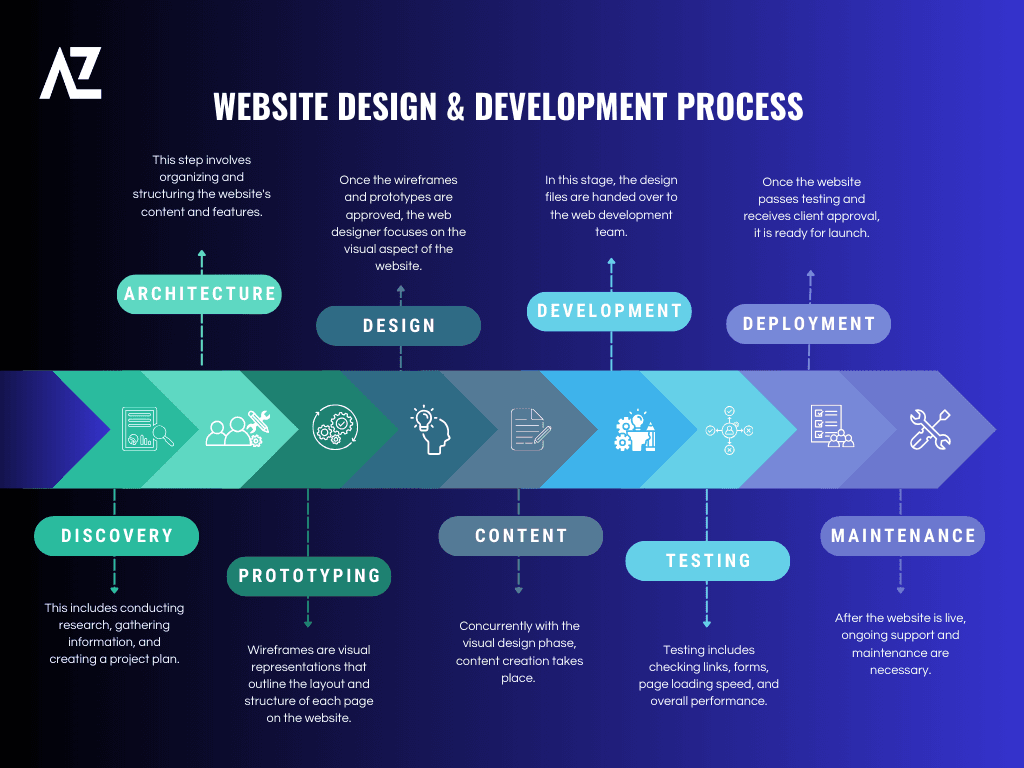
Understanding the Website Design & Development Process

Creating a website involves several key stages, each crucial for delivering a successful online presence. Understanding these steps can help you make informed decisions and work effectively with your development team.

web design and Development Process Steps Graph

1. Discovery

Description: The initial phase involves conducting thorough research to gather information and create a project plan.
Why it matters: This step ensures a clear understanding of your business goals, target audience, and competitive landscape, which will guide the entire development process.

2. Architecture

Description: This step focuses on organizing and structuring the website’s content and features.
Why it matters: Establishing a clear site architecture ensures that users can easily navigate your website and find the information they need.

3. Prototyping

Description: Creating wireframes that visually represent the layout and structure of each page on the website.
Why it matters: Wireframes provide a blueprint for the design and development teams, helping to visualize the user interface and identify potential usability issues early on.

4. Design

Description: Once the wireframes and prototypes are approved, the web designer focuses on the visual aspect of the website.
Why it matters: A well-designed website captures attention, reinforces your brand identity, and creates a positive user experience.

5. Content

Description: Concurrently with the visual design phase, content creation takes place.
Why it matters: High-quality, engaging content is essential for attracting and retaining visitors. Optimizing content for search engines also helps improve your website’s visibility.

6. Development

Description: In this stage, the design files are handed over to the web development team.
Why it matters: Developers use the design and content to build a fully functional website, integrating necessary features and functionalities.

7. Testing

Description: Testing includes checking links, forms, page loading speed, and overall performance.
Why it matters: Thorough testing ensures that your website functions correctly, provides a seamless user experience, and meets performance standards.

8. Deployment

Description: Once the website passes testing and receives client approval, it is ready for launch.
Why it matters: Deploying your website to a live server makes it accessible to the public, allowing you to start engaging with your target audience and achieving your business goals.

9. Maintenance

Description: After the website is live, ongoing support and maintenance are necessary.
Why it matters: Regular maintenance ensures that your website remains secure, up-to-date, and performs optimally over time. This includes addressing bugs, updating content, and implementing security patches.

By understanding these key steps, you can approach your website development project with confidence and collaborate effectively with your team to create a website that meets your business needs and delivers results.

Optimizing Your Website: Enhancing Performance, Content, Technical Aspects, and User Experience

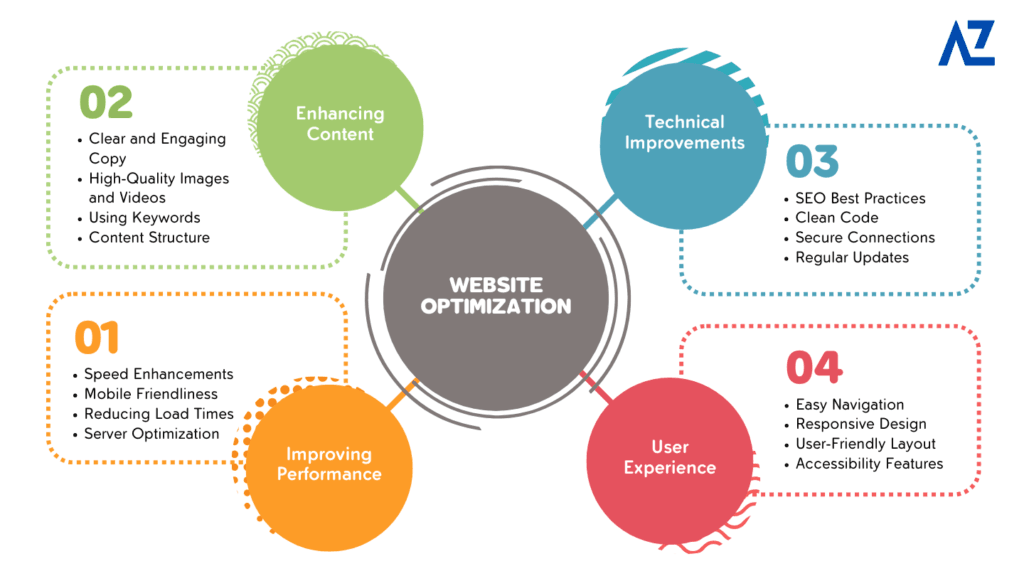
Website Optimization steps

Once your website is developed and deployed, the next crucial step is optimization. Website optimization ensures that your site not only looks great but also performs efficiently, provides valuable content, and delivers an excellent user experience. Here are key areas to focus on:

1. Improving Performance

Optimizing your website’s performance is critical for user engagement and search engine rankings. Key aspects include:

  • Speed Enhancements: Implement caching mechanisms, optimize images, and use Content Delivery Networks (CDNs) to reduce loading times.
  • Mobile Friendliness: Ensure your website is fully responsive and provides a seamless experience on all devices, including smartphones and tablets.
  • Reducing Load Times: Minimize HTTP requests, compress files, and leverage browser caching to speed up page loading.
  • Server Optimization: Optimize your server configuration to improve response times and handle traffic efficiently.

2. Enhancing Content

High-quality content is essential for attracting and retaining visitors. Focus on:

  • Clear and Engaging Copy: Craft compelling and informative text that resonates with your target audience and encourages them to take action.
  • High-Quality Images and Videos: Use visually appealing media to enhance your content and capture attention. Optimize images for web use to reduce file sizes.
  • Using Keywords: Incorporate relevant keywords naturally within your content to improve search engine visibility and attract targeted traffic.
  • Content Structure: Organize your content logically using headings, subheadings, bullet points, and white space to improve readability and engagement.

3. Technical Improvements

Technical aspects play a crucial role in your website’s success. Ensure you address the following:

  • SEO Best Practices: Implement proper title tags, meta descriptions, header tags, and URL structures to improve search engine rankings.
  • Clean Code: Write well-structured, semantic HTML and CSS to improve website performance and maintainability.
  • Secure Connections: Implement HTTPS to protect user data and build trust.
  • Regular Updates: Keep your website’s software, plugins, and themes up to date to address security vulnerabilities and ensure compatibility with the latest web standards.

4. User Experience

Providing a positive user experience is vital for converting visitors into customers. Focus on:

  • Easy Navigation: Design an intuitive navigation menu that allows users to easily find the information they need.
  • Responsive Design: Ensure your website adapts seamlessly to different screen sizes and devices.
  • User-Friendly Layout: Create a clean, uncluttered layout that makes it easy for users to read and interact with your content.
  • Accessibility Features: Implement accessibility features such as alt text for images, keyboard navigation, and sufficient color contrast to ensure your website is usable by people with disabilities.

By focusing on these four key areas—performance, content, technical aspects, and user experience—you can optimize your website to attract more visitors, improve engagement, and achieve your business goals.

Finding Value in Website Development Services

Value in website development comes not just from low prices but from results that support your business goals. Here are strategies to maximize the return on your website investment.

Focus on Business Objectives Rather Than Features

Start by clearly defining what your website needs to accomplish for your business. Prioritize features that directly support lead generation, sales, or customer service rather than adding elements that don’t contribute to these goals.

This objective-focused approach helps control costs by eliminating unnecessary features while ensuring you invest in elements that generate returns. Often, a simpler website that effectively converts visitors into customers provides better value than a feature-rich platform that doesn’t support business goals.

Evaluate Development Partners Beyond Price

The cheapest development option rarely delivers the best value. Research potential partners thoroughly by examining their portfolios, reading client testimonials, and evaluating their communication and project management approaches.

Experienced developers might charge more hourly but often deliver better results in less time. They help you avoid common pitfalls, suggest effective solutions, and create websites that require fewer fixes or revisions. Their expertise translates into better performance, security, and user experiences that generate more business value over time.

Consider Total Cost of Ownership

Initial development represents only part of your website’s total cost. Evaluate ongoing expenses like maintenance, updates, content changes, and marketing when comparing proposals. Some development approaches offer lower upfront costs but higher long-term expenses.

Websites built on common platforms generally have lower maintenance costs because finding support is easier. Custom solutions might better fit your specific needs but typically cost more to maintain and update. Understanding these tradeoffs helps you make decisions that align with both your current budget and long-term financial planning.

Website Maintenance and Ongoing Costs

Your website requires ongoing investment to remain effective, secure, and competitive. Understanding these costs helps you budget appropriately for the complete lifecycle of your digital presence.

Regular Maintenance and Updates

Basic maintenance packages typically cost between ₹3,000 and ₹10,000 monthly, covering security updates, regular backups, performance monitoring, and minor content changes. More comprehensive support packages range from ₹10,000 to ₹30,000 monthly.

Regular maintenance prevents security vulnerabilities, ensures compatibility with new browsers and devices, and maintains performance as your content grows. While representing an ongoing expense, proper maintenance protects your initial investment and prevents costly emergency fixes or rebuilds.

Content Updates and Marketing

Content updates and digital marketing represent additional ongoing investments. Content creation typically costs between ₹2,000 and ₹10,000 per piece, while comprehensive digital marketing services start from ₹15,000 monthly.

Fresh content drives ongoing traffic and improves search visibility, while marketing efforts attract new visitors and convert them into customers. These activities transform your website from a static information source into an active business development tool continuously generating new opportunities.

Making Smart Website Investment Decisions

Investing in website development requires balancing immediate budget constraints with long-term business goals. Here are final considerations to guide your decision-making process.

Start With Core Functionality and Expand Later

Consider a phased approach where you begin with essential features and add capabilities as your business grows. This strategy allows you to launch sooner and generate returns while spreading development costs over time.

Many successful websites evolve through multiple iterations, adding features based on actual user feedback rather than initial assumptions. This approach often delivers better results than trying to build every possible feature in the first version.

Invest in Quality Where It Matters Most

Allocate your budget strategically by investing more in elements that directly impact business results. User experience, clear messaging, and effective calls to action typically deliver better returns than decorative elements or rarely-used features.

The visible design is important, but back-end performance, security, and mobile optimization often have greater impacts on conversion rates and search visibility. Balance aesthetics with these functional aspects to create websites that not only look good but also perform effectively.

Consider Your Website a Business Investment

Frame your website as an investment rather than an expense. A well-designed website generating leads or sales often delivers returns many times its cost over its lifetime. This perspective helps you make decisions based on potential returns rather than just minimizing costs.

Set specific goals for your website—whether lead generation, sales, or customer service improvements—and measure its performance against these objectives. This approach helps you evaluate whether your investment is delivering appropriate returns and guides future enhancement decisions.

Frequently Asked Questions (FAQs)

  1. How much does it cost to build a basic website in India?

    A basic informational website in India typically ranges from ₹10,000 to ₹25,000. This covers a simple design, mobile responsiveness, and essential pages like “About Us” and “Contact.”

  2. What factors influence the cost of website development in India?

    Key factors include the type of website (informational, e-commerce, custom), design complexity, functionality requirements, content creation, and ongoing maintenance.

  3. Is it cheaper to develop a website in India compared to other countries?

    Yes, website development costs in India are significantly lower than in countries like the USA or Europe, often offering similar quality at a fraction of the price.

  4. What is the difference between template-based and custom website development?

    Template-based development uses pre-designed templates, making it more economical. Custom development involves building a website from scratch, offering greater flexibility but at a higher cost.

  5. How important is website maintenance, and what does it typically cost

    Website maintenance is crucial for security, performance, and keeping content up-to-date. Basic maintenance packages range from ₹3,000 to ₹10,000 monthly.

  6. What is the ROI (Return on Investment) of investing in a professional website?

    A professional website can significantly boost lead generation, sales conversions, and brand credibility, making it a worthwhile investment for businesses of all sizes. ROI depends on how effectively the website aligns with business goals.

  7. What is the average cost of e-commerce website development in India?

    E-commerce website development in India typically ranges from ₹75,000 to ₹3,50,000, depending on the number of products, payment gateway integrations, and custom features.

  8. Where can I find reliable website development services in India?

    Looking for professional and affordable website development services in India? AppZime Technologies offers custom solutions tailored to your business needs. Contact us today for a free consultation!

Conclusion: Balancing Cost and Value in Website Development

Website development costs in India offer excellent value compared to global markets, but the right investment depends on your specific business needs and goals. By understanding the factors that influence pricing, you can make informed decisions that balance your budget constraints with your digital ambitions.

Remember that your website represents your business in the digital world, often creating first impressions that influence purchasing decisions. Investing appropriately in this crucial business asset helps you establish credibility, reach new customers, and grow your business in an increasingly digital marketplace.

Whether you choose a simple informational site or a complex e-commerce platform, focus on creating digital experiences that support your business objectives and deliver value to your customers. With careful planning and the right development partner, your website can become one of your most effective business development tools.

Cost to Hire Best IT Staff in Mumbai

In today’s fast-paced digital world, hiring the right IT staff is crucial for businesses to stay competitive. Building a skilled IT team can make or break your success, whether you’re a startup or an established enterprise. But how much does it cost to hire best IT staff in Mumbai?

From developers and DevOps engineers to UI/UX designers and IT consultants, the cost of hiring IT professionals varies based on experience, skills, and demand. In this blog, we’ll break down the costs of hiring IT staff in Mumbai, explore factors influencing pricing, and provide actionable insights to help you make informed decisions.

Why Hiring IT Staff in Mumbai is a Smart Move

Mumbai, India’s financial and tech hub, is home to a vast pool of IT talent. With a thriving startup ecosystem and a growing demand for tech solutions, businesses in Mumbai have access to skilled professionals across various domains. However, the cost of hiring IT staff depends on several factors, including:

  • Experience Level: Junior vs. Senior professionals.
  • Skill Set: Niche skills like AI/ML, blockchain, or cloud computing.
  • Hiring Model: Full-time, part-time, or contract-based.
  • Location: Costs may vary within Mumbai (e.g., Andheri, Powai, or Navi Mumbai).

Cost Breakdown: Hiring IT Staff in Mumbai

In Mumbai, the cost to hire IT staff for your business can range from ₹50,000 to ₹2,00,000 depending on the specific role, experience level of the candidate, and the recruitment method used, with the average cost per hire often falling around ₹1,00,000; this includes factors like recruitment agency fees, advertising costs, interview expenses, and onboarding costs, which can add up to roughly 20-30% of the candidate’s annual salary. refine this and add it to to blog post

Here’s a detailed breakdown of the average costs to hire IT staff in Mumbai:

RoleExperience LevelAverage Annual Salary (INR)Hourly Rate (INR)
Software DeveloperJunior4,00,000 – 6,00,000500 – 800
Software DeveloperSenior10,00,000 – 18,00,0001,500 – 2,500
DevOps EngineerMid-Level8,00,000 – 12,00,0001,200 – 1,800
UI/UX DesignerJunior3,50,000 – 5,50,000400 – 700
UI/UX DesignerSenior8,00,000 – 12,00,0001,200 – 2,000
Data ScientistMid-Level10,00,000 – 15,00,0001,500 – 2,200
IT Project ManagerSenior15,00,000 – 25,00,0002,000 – 3,500

Note: These approximate figures may vary based on market trends and individual negotiations.

Factors Influencing the Cost of Hiring IT Staff

Experience and Expertise:

  • Junior professionals cost less but require training.
  • Senior professionals command higher salaries but bring expertise and efficiency.

Skill Set:

  • Niche skills like AI, blockchain, or cloud computing increase hiring costs.
  • General IT roles (e.g., web development) are more affordable.

Hiring Model:

  • Full-Time: Higher cost but ensures dedicated resources.
  • Part-Time/Contract: Cost-effective for short-term projects.
  • Remote Hiring: Can reduce costs but may require additional management.

Location:

  • Hiring in prime areas like Andheri or Powai may cost more due to higher living expenses.
  • Navi Mumbai or Thane may offer more affordable options.

Demand and Supply:

  • High-demand roles (e.g., DevOps, AI/ML) often come with premium pricing.

Hiring Trends in Mumbai (2024)

  1. Rise of Remote Work: Many companies are adopting hybrid or fully remote models, reducing the need for office space and expanding the talent pool.
  2. Demand for Niche Skills: Skills like AI, blockchain, and cloud computing are in high demand, driving up salaries for these roles.
  3. Focus on Employee Retention: Companies are investing in employee engagement and retention programs to reduce turnover costs.
  4. Increased Use of Recruitment Agencies: Businesses are partnering with staffing agencies like AppZime Technologies to streamline hiring processes.

Comparison of Hiring Models

Hiring ModelProsConsBest For
Full-TimeDedicated resources, long-term commitmentHigher cost, fixed overheadsBusinesses with steady workloads
Part-TimeCost-effective, flexibleLimited availability, less commitmentShort-term or seasonal needs
Contract-BasedProject-specific, no long-term commitmentHigher hourly rates, less loyaltyShort-term projects
Remote HiringAccess to global talent, cost savingsTime zone differences, communication challengesBusinesses with flexible policies

Tips to Reduce Hiring Costs

  1. Leverage Internships: Hire interns for entry-level tasks and train them for long-term roles.
  2. Outsource Niche Skills: Partner with IT staffing agencies for specialized roles.
  3. Remote Hiring: Consider hiring remote IT staff to save on office space and overhead costs.
  4. Use Freelancers: For short-term projects, freelancers can be a cost-effective solution.

Steps to Hire the Best IT Staff from AppZime Technologies

Steps to Hire Best IT Staff  in Mumbai

Step 1: Define Your Requirements

  • Identify Roles: Determine the IT roles you need (e.g., developers, DevOps engineers, UI/UX designers).
  • Skill Set: List the required technical skills (e.g., Python, React, AWS).
  • Experience Level: Specify the experience range (e.g., 2-4 years, 5+ years).
  • Hiring Model: Decide on full-time, part-time, or contract-based hiring.

Step 2: Contact AppZime Technologies

  • Reach Out: Contact AppZime via:
       Phone: +91 6393262563
       Emailbusiness@appzime.com
       Website
    www.appzime.com
  • Share Requirements: Provide details about the roles, skills, and experience you seek.

Step 3: Consultation and Planning

  • Free Consultation: Schedule a free consultation with AppZime’s experts.
  • Discuss Goals: Share your business goals, project scope, and timeline.
  • Custom Plan: AppZime will create a tailored hiring plan based on your needs.

Step 4: Review Pre-Vetted Profiles

  • Receive Profiles: AppZime will share pre-vetted candidate profiles that match your requirements.
  • Evaluate Skills: Review resumes, portfolios, and technical expertise.
  • Shortlist Candidates: Select candidates for interviews.

Step 5: Conduct Interviews

  • Technical Interviews: AppZime can assist with technical assessments to evaluate coding skills and problem-solving abilities.
  • Cultural Fit: Assess candidates for alignment with your company culture and values.
  • Finalize Selection: Choose the best candidate(s) for the role.

Step 6: Onboarding and Integration

  • Offer Letter: Extend the job offer to the selected candidate(s).
  • Onboarding Support: AppZime assists with paperwork, tools, and training.
  • Team Integration: Ensure smooth integration of the new hire into your team.

Step 7: Ongoing Support

  • Performance Monitoring: AppZime offers support to ensure the hired staff meets expectations.
  • Feedback Loop: Provide feedback to AppZime for continuous improvement.
  • Scaling Up: If needed, AppZime can help you scale your team with additional hires.

Why Partner with AppZime Technologies?

At AppZime Technologies, we understand the challenges of hiring IT staff in Mumbai. Whether you’re looking for full-time employees, contract-based professionals, or remote talent, we offer tailored IT staffing solutions to meet your business needs.

Our services include:

  • Pre-Vetted Talent: Access to skilled IT professionals.
  • Flexible Hiring Models: Full-time, part-time, or contract-based.
  • Cost-Effective Solutions: Transparent pricing with no hidden costs.

Conclusion

Hiring IT staff in Mumbai doesn’t have to be a daunting or expensive process. By understanding the costs and factors involved, you can make informed decisions that align with your business goals. Whether you’re building a new team or scaling your existing one, AppZime Technologies is here to help.

Ready to hire top IT talent for your business? Contact us today for a free consultation!


Tech Journal | AppZime Technologies