Software Development | AppZime Technologies

SaaS Tenant Isolation: How to Keep Customer Data Separate

A customer signs in to your SaaS product, opens a project, and downloads a file. Everything looks normal. The question behind SaaS tenant isolation is whether your system can keep that customer’s data separate throughout the journey—even if someone requests another customer’s project directly.

A login screen cannot answer that on its own. Neither can a separate database if a background worker later exports the wrong records. Isolation is the boundary that needs to hold wherever customer data goes.

Let’s make that less abstract. We’ll follow a fictional project-management product with two customer workspaces, then use it to compare architecture choices and decide what the team needs to test before release.

First, agree what a tenant actually is

In this example, a tenant is a customer workspace. Each workspace owns projects, files, and export history. A person can belong to more than one workspace, so “user” and “tenant” are different things.

That distinction matters as soon as someone switches workspaces. The application needs to know which workspace they are acting in, whether they still belong to it, and what they are allowed to do there. Knowing who logged in is only the beginning.

Imagine Maya belongs to workspace A. She asks the API for a project that belongs to workspace B. Even if she knows the project’s exact identifier, the application must reject the request unless a deliberate sharing rule gives her access.

That is the core promise to write down: ordinary workspace operations can only reach resources authorised for that workspace and person. If your product supports partners, shared projects, or customer-support access, describe those permissions explicitly too.

AWS’s explanation of tenant isolation is useful here because it separates identifying a user from keeping tenant resources apart. It also explains why a consistent enforcement mechanism matters: one forgotten check should not decide whether another customer’s records become visible.

Choose the boundary you need before choosing the database

Architecture discussions often jump straight to “one database or many?” A better opening question is: what do we need to separate, and why?

Keeping records confidential is one requirement. Protecting shared resources from an unusually heavy workload and restoring one customer’s data independently are two others. A design can handle one well and still need work on the others.

For our project-management product, suppose many small customers use the same features. Sharing application servers and database tables could make provisioning and updates simpler. But if a customer requires a dedicated database, the team needs to explain exactly which boundary that adds and what remains shared.

ApproachWhat it meansWhat the team takes on
PoolCustomers share resources, such as tables containing tenant-labelled rowsConsistent controls on every access path, plus attention to shared-resource pressure
BridgeSome layers are shared and others are separatedRouting and maintaining the different boundaries deliberately
SiloA chosen resource stack is dedicated to one tenantProvisioning, upgrades, monitoring, and recovery across that fleet

These names describe an approach, not a universal security rating. Say which layer you mean. “Dedicated database, shared application servers” tells a reviewer more than “we use a silo model.”

The AWS PostgreSQL decision matrix compares more specific storage choices, including separate clusters, databases, schemas, and shared tables. It highlights the operating work around deployment, connections, and recovery as well as infrastructure cost.

Use those trade-offs to ask what your team can maintain. A fleet of separate databases still needs reliable permissions and upgrades. A shared database still needs a credible answer when a customer asks for an export, deletion, or restore.

Follow one request from the browser to the database

Maya opens a project in workspace A. The browser sends the project ID and the selected workspace. Treat both as a request for access, rather than evidence that access is allowed.

The server verifies Maya’s identity, confirms her current membership in A, and checks whether her role permits the requested action. It then looks up the project within that authorised context. If the project belongs to B, the request must not succeed.

This is object-level authorisation: permission to call an API does not automatically mean permission to access every object behind it. OWASP’s API security guidance explains this failure pattern and why checks belong wherever an endpoint accepts an object identifier.

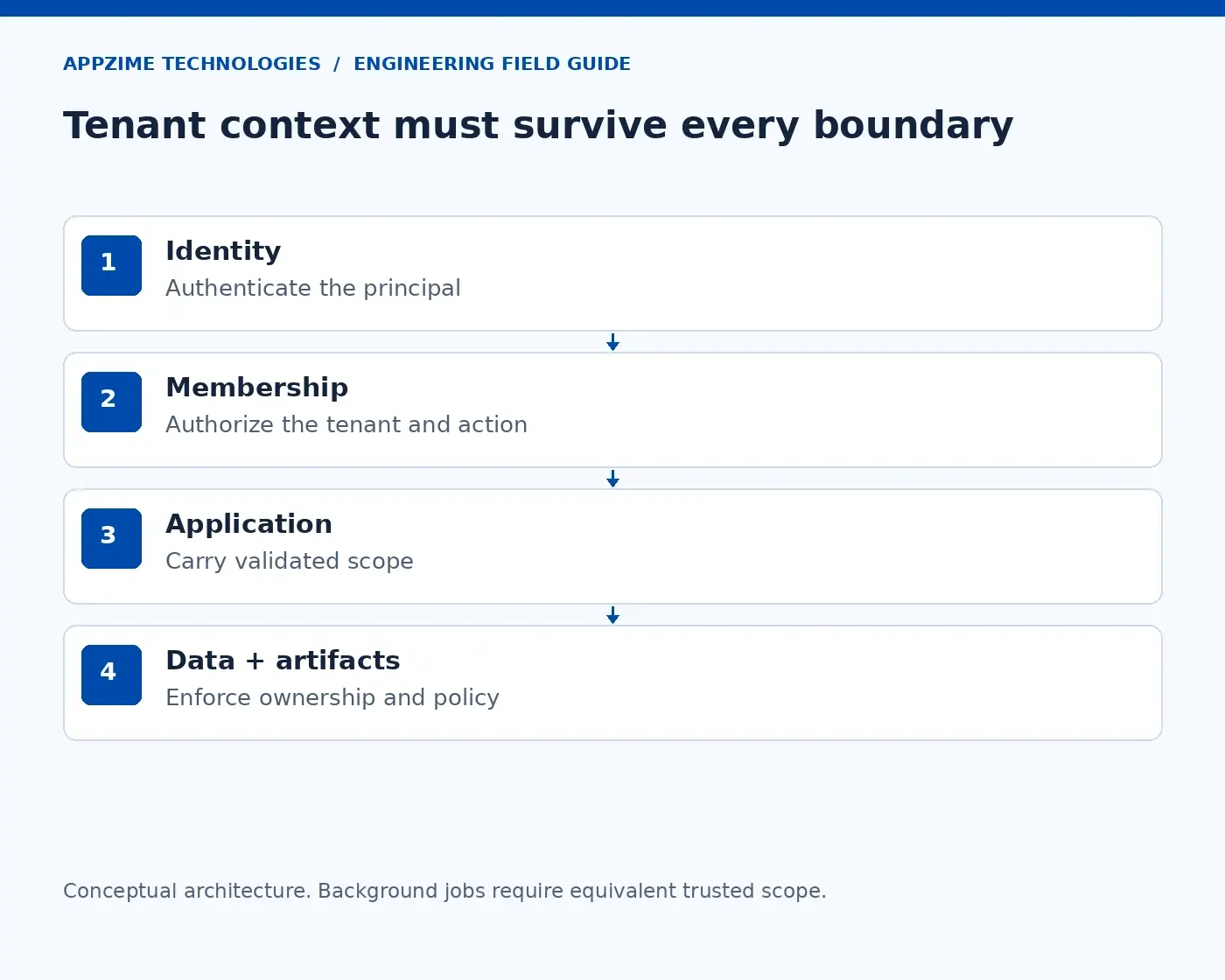
SaaS tenant isolation: Tenant context must survive every boundary. Conceptual architecture. Background jobs require equivalent trusted scope.
Follow trusted tenant context through the application and its data access. Background jobs need the same attention. Open full-size visual.

The diagram follows that context through the system. The important part is the handoff: each service needs a trustworthy way to know which tenant is in scope and what the caller may do. A tenant ID copied from an untrusted header does not establish either.

Apply the same reasoning when creating or updating a project. The server should not accept a different tenant ID hidden in the request body simply because the person was allowed to edit a project. Both the existing resource and the proposed change need to stay within the authorised boundary.

Then consider a legitimate workspace switch. Maya might belong to both A and B, with different permissions in each. Selecting B should trigger the appropriate membership and role checks; it should not reuse A’s permissions because the person has stayed logged in.

Use row-level security carefully in a shared database

When customers share PostgreSQL tables, row-level security, or RLS, can help limit which rows a database role may read or change. Think of it as an additional rule at the data layer, closer to where a missing application filter could cause harm.

For the projects table, a policy can be designed around the trusted tenant context. The application still has to establish that context correctly. A database policy cannot tell whether an arbitrary workspace value supplied by a caller is legitimate.

There is also an important testing detail in the PostgreSQL row-security documentation: superusers and roles with BYPASSRLS bypass these policies, and table owners normally do as well. Test with the role the application actually uses, including the policy settings that apply to it.

A demo run under an administrator account can therefore give you the wrong impression. The useful question is whether the deployed application role receives the expected allowed and denied results.

Connection reuse deserves its own test. Database pools reuse connections across requests; tenant context must not leak from one request into the next. Review how your driver and pooler handle that context, including when a transaction fails.

RLS also does not give each customer independent compute or a separate recovery process. It solves a particular access-control problem. Keep the rest of the architecture decision visible rather than treating one feature as the whole isolation plan.

Keep the boundary intact when the request becomes a job or file

Now Maya clicks “Export projects.” The API queues work and responds before the file is ready. The original browser request is over, but the responsibility to keep customer data separate continues.

The worker needs a validated tenant scope and an authorised reason to produce that export. It should read only the intended records, store the output under the correct ownership, and deliver it through an access-controlled path. A global worker account should not turn an unchecked message field into authority.

File downloads raise a similar question. A tenant name in a storage path helps organise objects, but it is not proof that the requester may receive them. Check access to the file before issuing a download link, and choose the link’s scope and lifetime deliberately.

Next, look at the product’s shortcuts. Ask whether a cached response could reach the wrong person, or search could reveal a document title from B even when opening the document is blocked. The boundary includes metadata and exports as well as the main project page.

Path in our exampleQuestion to answer
Project APIAre user, workspace, action, and project ownership checked together?
Background exportDoes validated workspace scope survive the queue and worker?
File downloadIs the requester authorised before a download capability is issued?
Cache and searchCan results or metadata escape the access rules?
Support toolingIs exceptional access limited, approved, and recorded?

This walkthrough often exposes a more useful design question than the database diagram alone: who owns each handoff? If the API team assumes the worker validates scope and the worker team assumes the API already did everything, write down the missing contract before release.

Test the design with two customers, not just one happy path

Create synthetic workspaces A and B, each with known projects and files. Add a member of A, a member of B, a person who belongs to both, and someone whose membership has been removed.

Known identifiers make the test stronger. Ask for B’s project while signed in as A’s member; submit B’s tenant ID in a write request; try the equivalent export and download paths. The goal is to establish whether the access rules hold, not whether identifiers are difficult to guess.

Then exercise the parts that share state: concurrent requests through the connection pool, repeated requests through the cache, and queued work that runs after a permission change. Decide what revocation should mean for outstanding jobs and previously issued download links.

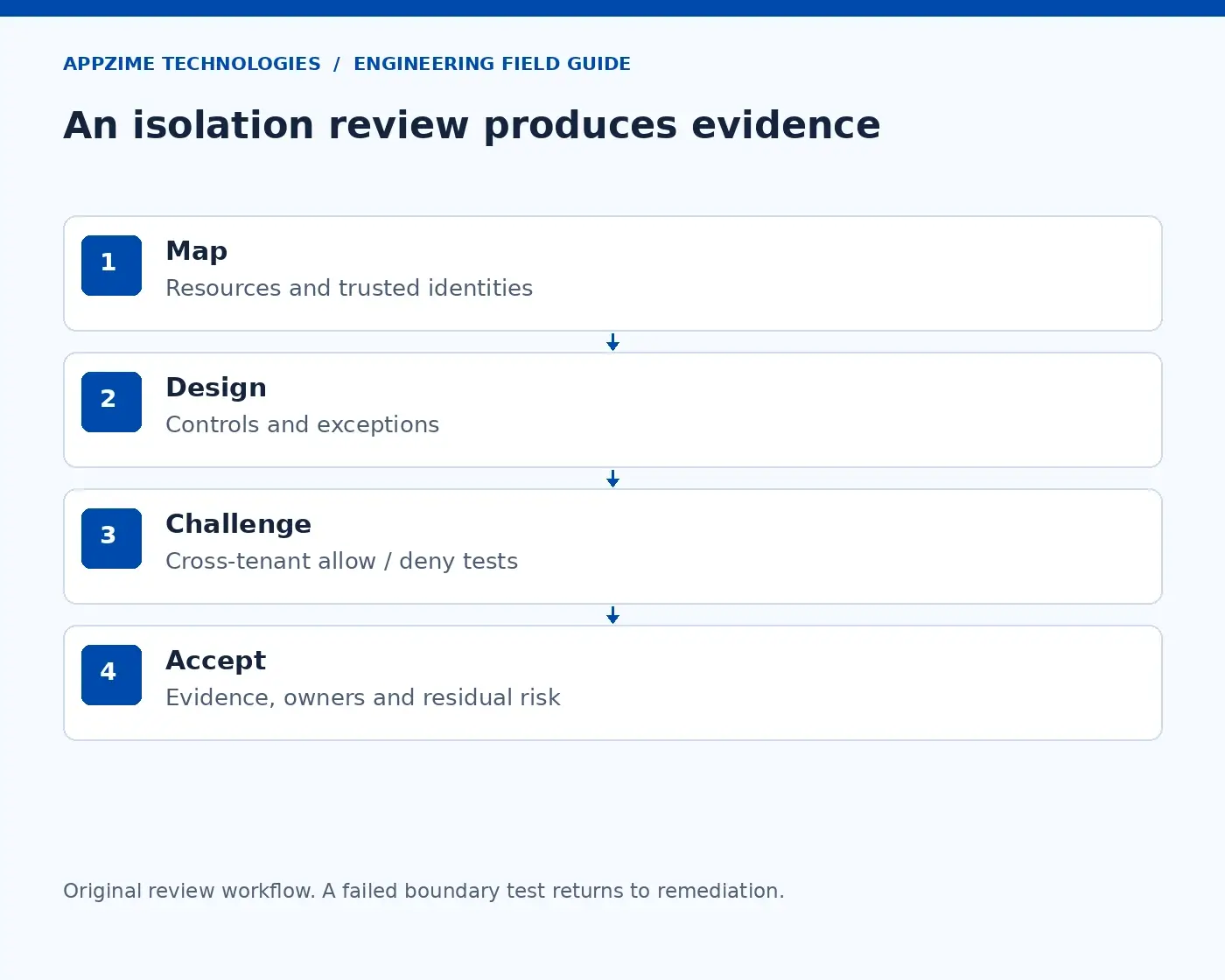
An isolation review produces evidence. Original review workflow. A failed boundary test returns to remediation.
Map the boundary, test the controls, and take unexpected results back to the responsible owner. Open full-size visual.

The review workflow is a loop. Map a resource, identify the control, test it, and take any unexpected result back to the responsible owner. A failed check should change the design or implementation rather than disappear into a list of accepted assumptions.

Record successful access too. A system that blocks everyone has not met the product requirement. Your evidence should show that the right person can complete the right task while another tenant cannot.

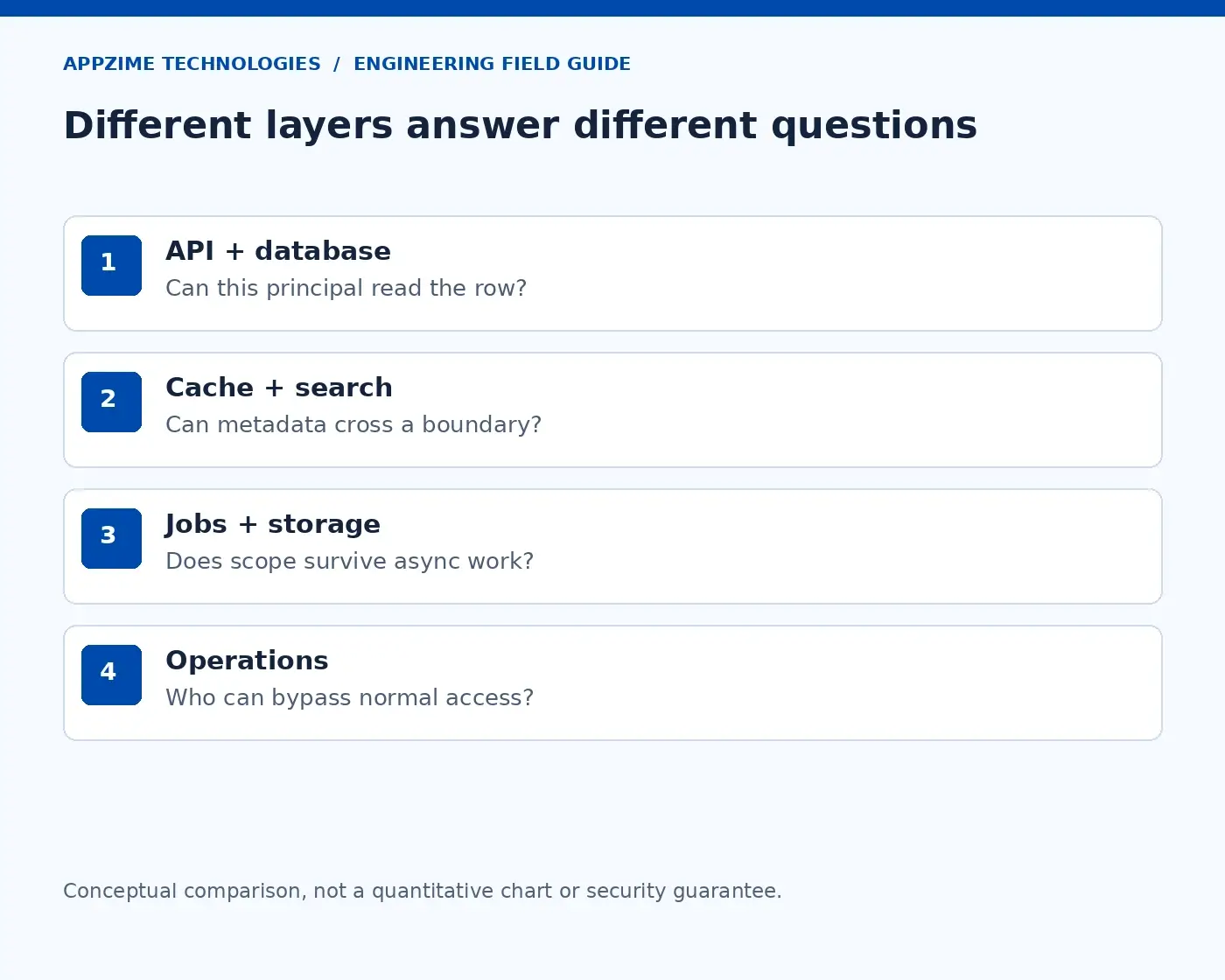
Different layers answer different questions. Conceptual comparison, not a quantitative chart or security guarantee.
Application, database, and operational controls address different parts of the customer-data boundary. Open full-size visual.

The layers in this visual answer different questions. Application rules understand the action, database rules constrain data access, and operational processes govern the people and services with exceptional privileges. Review them together.

Bring nine clear answers to the architecture review

By this point, the team should be able to explain its choices without relying on “the framework handles it.” Use these questions to turn the discussion into something another engineer can inspect:

  1. What is a tenant, and what sharing is intentional?
  2. Which records, files, indexes, and exports belong to it?
  3. Who establishes trusted user and tenant context?
  4. Where is each read and write permission enforced?
  5. Which database role runs the application?
  6. What happens when connections and cached results are reused?
  7. How do jobs and downloads preserve scope?
  8. Who may cross the normal boundary for support or operations?
  9. How are provisioning, revocation, and recovery tested?

Each answer needs an owner and evidence. That might be a policy review, a reproducible test, or a restore exercise. The exact artifact matters less than whether someone can check the claim.

If you are also building the wider quality plan, AppZime’s SaaS test-automation guide covers that related work. Keep isolation checks tied to the architecture instead of treating them as a final security test after the product is finished.

Choose a model your team can keep operating

The right design needs to work during a normal release, an incident, and a customer’s departure. Include tenant deletion, backup handling, and recovery in the decision—not only the cost of creating the first workspace.

A small team may have one person covering several responsibilities, but application logic, database policy, and access tests still need explicit ownership. When extra expertise is needed, define the gap: a backend engineer to carry context, a database specialist to review policies, or a QA engineer to maintain cross-tenant tests.

AppZime’s software development services and engineering staff augmentation support different delivery arrangements. Start a scoping conversation with your resource map and the unanswered questions, so the work has a clear purpose.

The result you want is straightforward: your team can follow a customer’s data through the product, explain the boundary at every step, and demonstrate that the boundary holds. That is a much stronger answer than the name of the database model alone.

Technical sources reviewed on 18 October 2026. The workspace example is fictional; implementation details depend on the selected platform and access model.

Mobile App Development Cost in India 2026: 9 Factors That Shape Your Budget

Mobile app development cost in India is one of the first questions businesses ask when they plan a new digital product. The useful answer is not a single fixed price. Cost depends on what the app must do, how many platforms it supports, the quality of its user experience, backend complexity, integrations, security, testing, and the team responsible for building and maintaining it.

This guide explains the main cost drivers in practical language so founders, product teams and enterprises can prepare a realistic budget before requesting quotations. Instead of relying on a generic price range, you can use the nine factors below to understand where development effort actually goes and where sensible product decisions can control spending.

What Determines Mobile App Development Cost in India?

The mobile app development cost in India should be estimated from scope and engineering effort rather than from the number of screens alone. Two applications can have the same number of screens but require very different work behind them. A simple catalogue application that reads public data is fundamentally different from a fintech application handling authentication, transactions, audit trails and third-party integrations.

A professional estimate normally breaks work into discovery, UI/UX, frontend development, backend engineering, APIs, quality assurance, deployment and post-launch support. This makes the estimate easier to challenge and helps prevent important work from being hidden inside a single headline figure.

1. Product Scope and Feature Complexity

The biggest cost driver is the number and complexity of features. Basic features such as onboarding, profiles, search, notifications and content display are relatively predictable. Complexity rises when the product needs real-time communication, payments, maps, live tracking, offline synchronization, video, AI, role-based permissions, complex workflows or integrations with existing enterprise systems.

Before development starts, divide requirements into must-have, should-have and later-stage features. A focused first release reduces development risk and gives the business a chance to validate real user behaviour before investing in every planned feature.

Useful scope questions

  • What is the single most important user outcome?
  • Which features are essential for launch?
  • Which features can wait until usage data exists?
  • Does the application need an admin portal?
  • Which external services must be integrated?

2. Android, iOS or Cross-Platform Development

Platform strategy changes both initial development and long-term maintenance. Native Android and iOS applications can provide deep platform-specific control, but separate codebases can require more engineering effort. Cross-platform frameworks can allow teams to share a meaningful portion of application code when the product requirements fit that approach.

The correct choice depends on product needs rather than a universal rule. Applications with highly specialized native functionality may justify separate native development. Many business applications can benefit from a shared approach if performance, device access and user-experience requirements are satisfied.

AppZime’s mobile app development services can support product discovery and architecture decisions before a business commits to a specific implementation path.

3. UI and UX Design Depth

Good design work is more than choosing colours and drawing screens. Product designers define navigation, information hierarchy, interaction states, empty states, errors, accessibility considerations and responsive behaviour. They also create prototypes that allow teams to find usability problems before those problems become expensive code changes.

A straightforward internal application may use a restrained component system. A consumer-facing product competing for attention may require deeper research, custom interactions, motion, extensive design systems and repeated usability testing. The more unique and interaction-heavy the experience, the more design and frontend effort it usually requires.

4. Backend, Database and API Requirements

Many mobile applications are only the visible layer of a larger software system. User accounts, permissions, content, orders, transactions and business rules typically live in backend services and databases. This infrastructure must be designed for reliability, security and future growth.

Backend effort increases with complex data relationships, high traffic, real-time processing, multiple user roles, audit requirements and connections to external platforms. If an organization already has reliable APIs, the mobile project may reuse them. If not, API design and backend engineering become part of the project.

For products that require a broader platform behind the mobile experience, AppZime also provides custom software development for backend systems, portals and business applications.

5. Third-Party Integrations

Integrations can save development time, but they still require engineering, testing and monitoring. Payment gateways, identity providers, maps, analytics, messaging, CRM systems, ERP platforms and cloud services each introduce external dependencies.

Teams should review API documentation, pricing, rate limits, authentication methods, data-handling rules and failure scenarios before treating an integration as a small task. An integration that works in a demonstration can still require substantial production work around retries, error handling and reconciliation.

6. Security and Compliance

Security should be planned from the beginning, especially for applications handling financial, healthcare, employee or other sensitive information. Common requirements include secure authentication, authorization, encrypted transport, secure storage, secrets management, logging and protection against common application vulnerabilities.

The OWASP Mobile Application Security project provides widely used guidance for mobile application security testing and controls. Teams can use resources from OWASP Mobile Application Security as a reference when defining security requirements.

Compliance-heavy applications may also need additional documentation, reviews, audit evidence and specialized controls. Those requirements should appear in the project estimate rather than being treated as an afterthought.

7. Testing and Quality Assurance

Testing effort grows with the number of devices, operating-system versions, user roles, integrations and workflows. Quality assurance should cover functional behaviour, error states, performance, permissions and regression risk. Automated tests can be valuable for stable, repeatable workflows, while exploratory testing remains important for discovering unexpected problems.

Skipping QA may make the initial quotation look cheaper, but defects found after launch can be significantly more disruptive because they affect users, reviews, support teams and release schedules.

8. Infrastructure, DevOps and Release Management

Production applications need environments, deployment processes, monitoring, backups and operational ownership. Teams may need development, testing and production environments with controlled configuration and access. Continuous integration and deployment can reduce manual release work and make frequent changes safer.

Cloud spending itself is only one part of operations. Engineering time for observability, incident response, scaling and maintenance should also be considered. AppZime’s DevOps services can help teams design repeatable delivery and infrastructure practices for software products.

9. Maintenance After Launch

A mobile application is not finished when it reaches an app store. Operating systems change, third-party APIs evolve, security issues are discovered and users request improvements. Businesses should reserve capacity for bug fixes, compatibility updates, monitoring, analytics and product iteration.

Google publishes ongoing Android developer guidance at Android Developers, while Apple maintains platform and submission documentation at Apple Developer. These ecosystems evolve continuously, which is one reason maintenance needs to be part of long-term planning.

Mobile App Development Cost in India: Practical Budgeting Framework

Planning area Lower-complexity approach Higher-complexity approach
Product scope Focused MVP Multiple workflows and advanced features
Platforms One platform or suitable cross-platform build Separate native experiences
Backend Simple APIs and data model Real-time, complex roles and integrations
Design Standard design system Custom interaction system and research
Security Standard business controls Regulated or highly sensitive workflows
QA Focused device and workflow matrix Large compatibility and automation matrix

This framework is more useful than choosing a vendor from a headline price. Ask every development partner to explain assumptions behind the estimate, what is excluded, how change requests are handled, who owns the source code and what happens after launch.

How to Reduce Cost Without Reducing Product Quality

  1. Validate the problem before building. Interviews and prototypes are cheaper than rebuilding the wrong product.
  2. Prioritize the first release. Launch the smallest version that can prove the core value.
  3. Reuse proven components. Authentication, analytics and other commodity capabilities do not always need custom reinvention.
  4. Clarify acceptance criteria. Ambiguous requirements create rework.
  5. Design for maintainability. Shortcuts that make future changes difficult can increase total cost.
  6. Measure after launch. Use real behaviour to decide which features deserve investment.

Questions to Ask a Mobile App Development Company

  • What assumptions are included in the estimate?
  • Who will own product discovery and technical architecture?
  • How are design changes and scope changes handled?
  • What testing is included?
  • How will security be reviewed?
  • Who owns the source code and cloud accounts?
  • What documentation will be delivered?
  • What support is available after launch?

FAQ About Mobile App Development Cost in India

Can an exact app cost be estimated from an idea alone?

Usually not responsibly. A useful estimate needs enough detail about users, features, platforms, integrations, security, backend requirements and expected quality. Early discovery can convert an idea into an estimateable scope.

Is cross-platform development always cheaper?

No. It can reduce duplicated work for suitable products, but the final economics depend on native integrations, performance needs, design requirements and long-term maintenance.

Should maintenance be included in the original budget?

Yes. Businesses should plan for monitoring, compatibility updates, bug fixes, security work and product improvements after launch.

What is the best way to compare development quotations?

Compare scope, assumptions, team composition, architecture, QA, security, ownership, support and exclusions. Two quotations with different scope are not directly comparable even when both describe the same app idea.

Final Takeaway

The mobile app development cost in India becomes easier to control when the product is clearly defined. Focus first on the business outcome, prioritize the launch scope, choose architecture based on actual requirements and insist on transparent estimates covering design, engineering, testing, deployment and maintenance.

If your organization is planning a new mobile product, AppZime can help with discovery, UI/UX, application engineering, backend development and production delivery. Start with a focused requirement rather than a fixed price target, and build the budget around the value and complexity of the product you actually need.

Appzime Logo

Tell us what kind of developer you need

Our AI will analyze your requirements and match you with vetted developers from our global talent pool efficiently and accurately

Upload Job Description

Drag and drop your PDF or DOCX here, or click to browse

Supported formats: PDF, DOCX (Max 10MB)

Takes ~15 seconds · No signup required

AI Neural Matching Engine
Signals extracted: 0

Intelligent Talent Matching

Our AI neural network is processing your requirements across millions of data points

Analyzing job description

Extracting key requirements and technical specifications

Extracting skills and experience

Identifying required technologies, frameworks, and expertise levels

Searching vetted developer profiles

Scanning our global database of pre-screened professionals

Matching candidates with requirements

Applying proprietary algorithm to find best-fit matches

Shortlisting best-fit developers

Ranking and selecting top candidates for your review

Neural Match

Matched Developers

AI-powered matching based on your requirements

AI VERIFIED
4 Candidates Matched
Analyzing requirements...

AI Extracted Requirements

Your Requirements

Need More Candidates?

Unlock full roster with detailed profiles, interview recordings, and salary expectations.

Appzime Logo

Get Instant Candidate Access

Fill in your details to unlock full candidate profiles and connect with top talent.

Detailed JD helps us match better candidates
Software Development | AppZime Technologies