


 Mobile App Development
 AI & ML
 IT Consulting
 Website Development
 Digital Transformation
 Software Development
 DevOps & Cloud Solutions
 Product Design & Ideation
 Hire Nodejs Developer
 Hire ReactJs Developer
 Hire AngularJs Developer
 Hire Flutter Developer
 Hire VueJs Developer
 Hire Android Developer
 Hire iOS Developer
 Hire Python Developer
 Hire DotNet Developer
 Hire Laravel Developer
 Hire PHP Developer
 Hire CodeIgniter Developer
 Hire Golang Developer
 Hire ROR Developer
 Hire SalesForce Developer


Effective contract developer onboarding gives a new engineer the context, access and review support needed to deliver a bounded first change safely. Assign an internal owner, provision only required access, establish a reproducible environment and agree acceptance criteria. Plan handover and access removal at the beginning of the engagement, rather than waiting until its final day.
Research reviewed: 18 October 2026. The 30-day sequence is an illustrative AppZime Technologies operating plan. It is not a promised delivery time or legal advice.
Define what the engagement is meant to accomplish
A contractor can join a team quickly and still spend weeks blocked by unclear requirements, inaccessible environments and absent reviewers. Onboarding is therefore a delivery responsibility shared by the receiving team and the staffing partner. It is not complete when an account invitation has been sent.
This playbook is for engineering managers, delivery leads and procurement teams bringing external developers into an existing codebase. It focuses on the transition from approved engagement to demonstrable delivery. AppZime’s remote-developer hiring guide addresses the earlier hiring decision.
Write the first workstream, expected outcome, internal acceptance owner and boundary of authority. Specify which systems the engineer needs, which data may be used and who can approve a production change. A contractor who is expected to discover requirements, own architecture and operate production needs a different scope from someone implementing a reviewed feature.
Commercial and legal terms need review by the relevant business owners. Confirm the engagement model, duration, invoicing basis, confidentiality, intellectual-property terms, approved equipment, location expectations and handover obligations. This article does not prescribe a universal employment or contractor classification.
Build a contract developer onboarding ownership map
Assign one accountable receiving manager. Identify the technical buddy, code reviewer, access approver and business acceptance owner. A staffing partner can coordinate personnel and commercial administration, but the customer team must still decide what access is appropriate and what work is accepted.
| Responsibility | Accountable owner | Evidence of completion |
|---|---|---|
| Scope and acceptance | Receiving engineering or product owner | Written first deliverable and definition of done |
| Identity and access | System owner or security administrator | Named access grant with approver and review date |
| Environment and context | Technical buddy | Reproducible setup and architecture walkthrough |
| Code review | Designated reviewer | Reviewed change and resolved comments |
| Commercial coordination | Authorized engagement owner | Approved terms, timesheet and invoice process |
| Exit and handover | Receiving manager with system owners | Transferred knowledge and verified access removal |
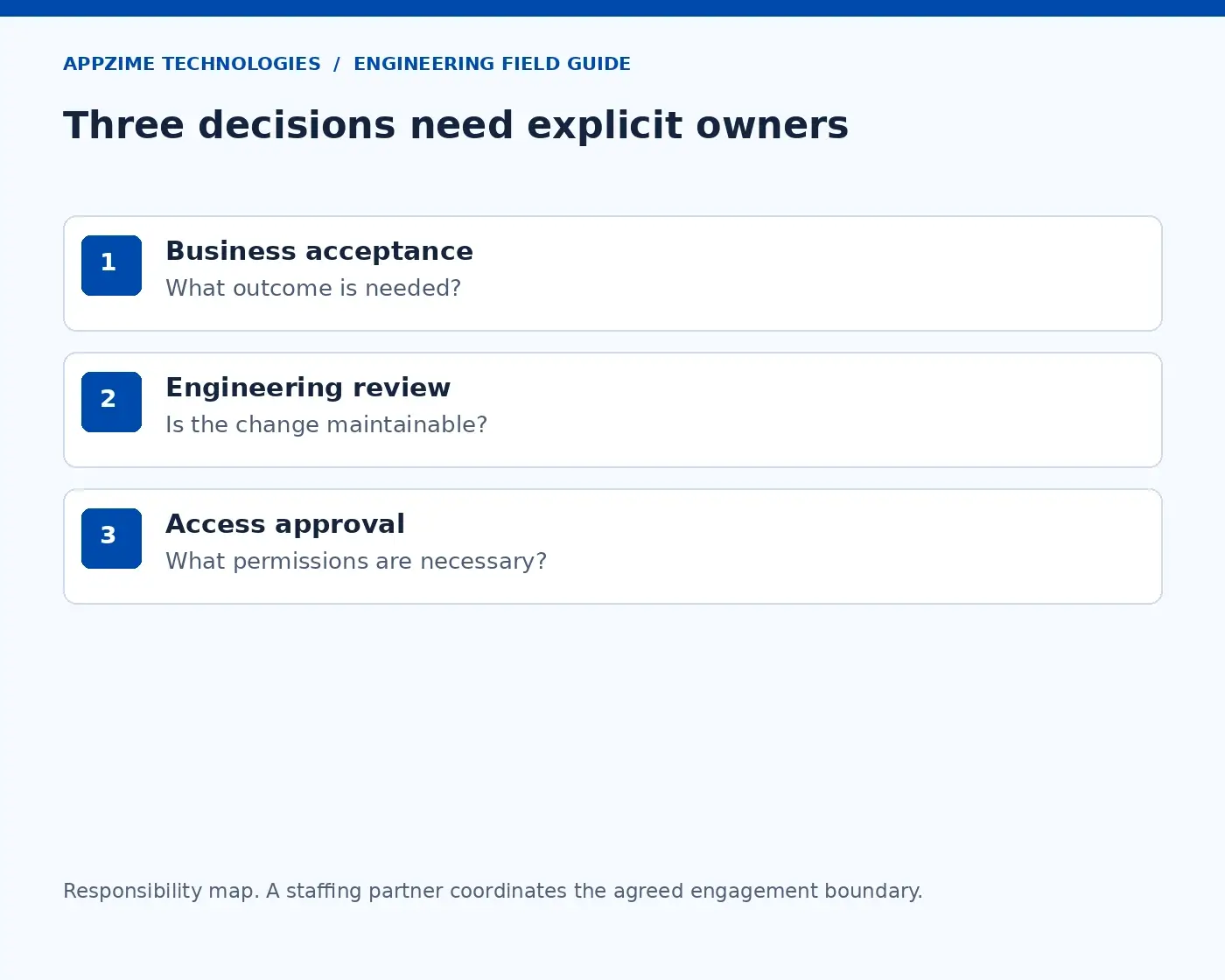
The ownership map connects business acceptance, engineering review and access approval. Those are separate decisions even when one small team performs all three. No staffing arrangement should make the authority to deploy or access customer data implicit.
Before day one: remove predictable blockers
Prepare a role-specific start pack. Include the product purpose, current architecture, repository map, local setup instructions, test commands, review conventions, support channel and first task. Avoid an unstructured folder containing every document the company has ever produced.
Make the first task small enough to review and meaningful enough to expose the normal development path. A documentation correction can prove account access, but it may not prove the application builds. A low-risk behavior change with an automated test can exercise setup, code ownership, CI and review without requiring broad production permissions.
Confirm the equipment and identity process before sharing proprietary code. Use the organization’s approved device and account policies. Do not solve a delayed account request by forwarding a colleague’s credentials or copying production data into a personal service.
NIST’s Secure Software Development Framework describes secure development practices across the software lifecycle. Its relevance here is organizational preparation and protection of software and development environments. Using this checklist does not establish certification or compliance with every applicable requirement.
Days one to three: prove the environment and access boundary
Start with an architecture walkthrough: who uses the product, what a request does, where data lives and how changes reach production. Explain customer-sensitive areas and known constraints. A recorded or written walkthrough helps future team members, but only if it is kept within approved information-sharing boundaries.
Then reproduce the build and test process from the documented instructions. Record missing steps in the onboarding issue. The useful acceptance condition is that the new engineer can run the agreed tests and explain the expected output. “It works on the buddy’s laptop” leaves the underlying dependency unresolved.
Grant access against the actual responsibility. GitHub’s repository-role documentation explains different permission levels and recommends matching access to function. Do not default every external engineer to administrator. Review inherited organization permissions as well as the direct repository grant.
Keep a simple access register: person, system, role, purpose, approver, grant date, review date and removal owner. Exclude passwords, tokens and secret values from that register. A list of intended grants is not evidence that removal later occurred; verify the final state in each system.
Week one: complete a reviewed first change
Choose a task with a clear user outcome and a narrow blast radius. Ask the engineer to write the proposed change, tests, assumptions and release considerations in a pull request. The reviewer should explain the reasons behind conventions that are unique to the codebase.
GitHub branch-protection features can support required reviews and status checks, subject to repository settings and plan availability. The operating decision remains with the team: what must pass, who can approve and which bypasses are allowed? Do not promise a control exists merely because a product offers it.
Avoid measuring success by the speed of the first merge alone. A rushed change with weak tests can create rework. Also avoid leaving the contractor waiting several days for a reviewer and then treating the delay as an individual performance problem. Agree a reasonable review service expectation and backup reviewer.
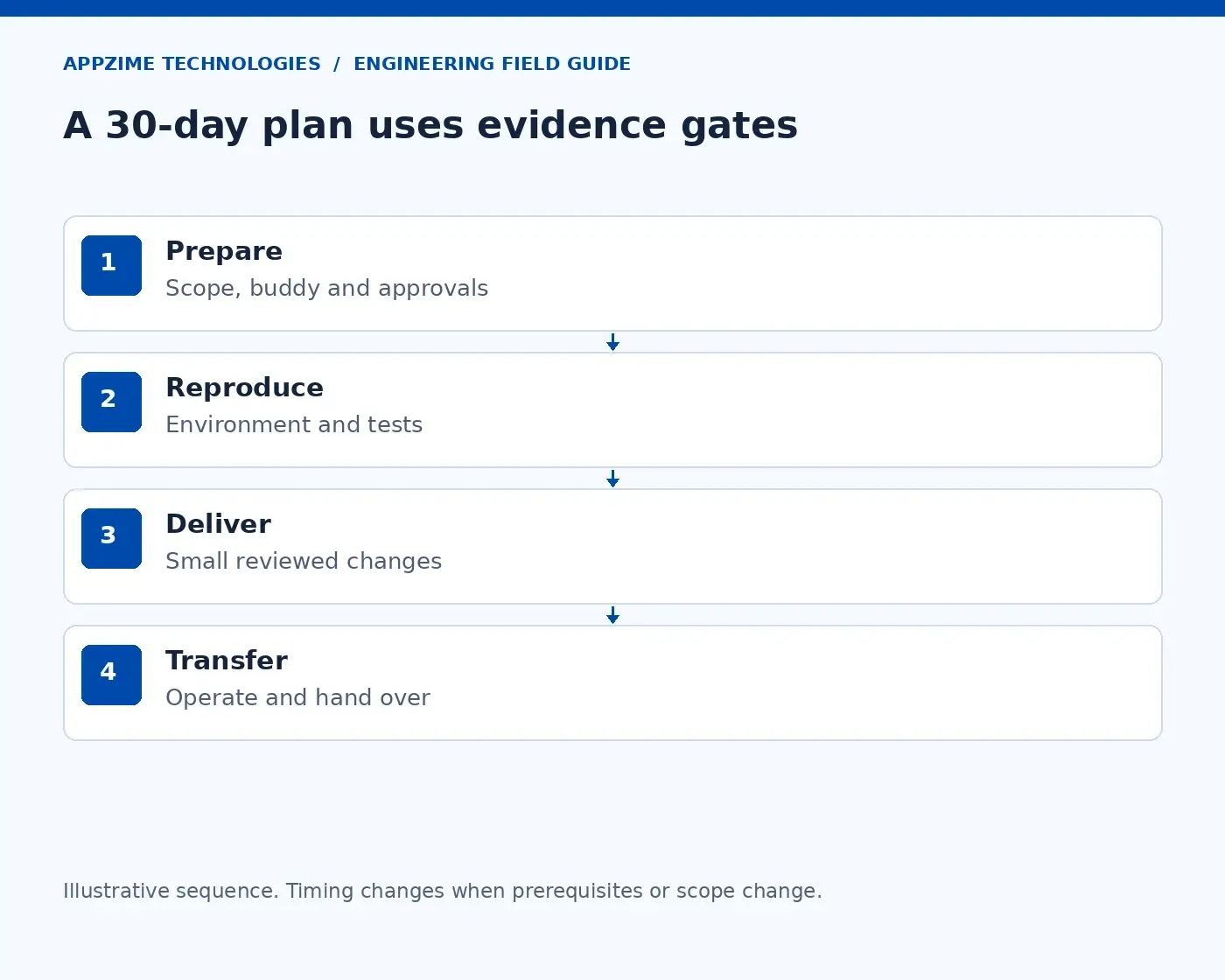
A worked 30-day delivery plan
Illustrative fictional example — not an AppZime Technologies client project or measured result. A product team engages a backend contractor to add a filtered activity-export endpoint. An internal lead owns API design and release approval. A product owner accepts the behavior. The contractor receives repository access and a synthetic test environment; production customer data is outside the initial scope.
| Stage | Deliverable | Acceptance condition | Owner |
|---|---|---|---|
| Before start | Brief, setup guide and access requests | Required approvals and reviewers identified | Receiving manager |
| Days 1–3 | Reproducible environment | Build and selected tests run from written steps | Contractor with buddy |
| Days 4–7 | Small reviewed change | Tests pass; reviewer accepts behavior and explanation | Reviewer |
| Week 2 | Endpoint contract and implementation | Filters, authorization and output format are reviewed | Technical lead |
| Week 3 | Failure and performance validation | Agreed limits and failure paths demonstrated in test | Engineering and QA |
| Week 4 | Release candidate and handover | Release owner accepts rollback notes and support instructions | Internal lead |
The dates are planning assumptions. If the API contract is unresolved or a dependency is unavailable, change the plan explicitly. Do not describe a blocked task as complete merely because its target date has passed. Record the dependency, owner, impact and revised next step.
For the export example, the definition of done includes the permission model, filter semantics, maximum result behavior, automated tests and handling of empty results. A large asynchronous export would require a different design and possibly a different access scope. The team should resolve that change rather than quietly expanding the original task.
Separate human access from pipeline access
The developer’s account, the CI runner and the application’s runtime identity have different purposes. A person may need to propose code without directly deploying it. A workflow may need a short-lived deployment capability without giving every contributor permanent cloud access.
GitHub’s OIDC guidance explains a method of requesting short-lived cloud tokens through configured trust. AWS IAM guidance also emphasizes temporary credentials and appropriately scoped access. These principles inform the onboarding design; their adoption requires platform-specific review.
Review package registries, monitoring tools, support consoles, document spaces and shared service accounts as well as source control. Access often survives in a secondary system even after the main account is removed. Assign ownership for those dependencies before the engagement begins.
Documented practices from GitLab and Google
GitLab: its remote-onboarding handbook describes structured onboarding and the role of an onboarding buddy. It encourages new team members to improve documentation when they encounter obstacles. The transferable practice is a named support person and an evolving written path. The handbook is company-authored operational guidance, not independent evidence that a particular contractor will reach productivity within 30 days.
Google: its published code-review practices describe review of design, behavior, tests, clarity and documentation. They provide a useful basis for making review expectations explicit. They do not imply that another organization should copy every internal convention or that review removes all defects. Neither company is represented as an AppZime client.
Manage cost, capacity and blocked work
Estimate the receiving team’s effort as well as the contractor’s billable hours. Include setup support, architecture discussions, review, QA, access administration and handover. A low hourly rate can be misleading if the engagement has no acceptance owner or if every task waits on an overloaded lead.
Use a transparent planning model: external engineering time plus internal buddy and review time, approved tooling, test infrastructure and transition effort. If you assign hypothetical hours, label them as assumptions and adjust them using the actual first-week experience. This guide provides no market-rate or guaranteed savings claim.
Maintain a blocker log with the blocked outcome, dependency, owner, time first observed and next decision. Review it in a short delivery check-in. A contractor should be able to raise a concern without being encouraged to bypass security controls to look productive.
Plan handover and offboarding from the start
Handover is a continuing activity. Keep design decisions, test instructions and operational notes alongside the work. Ask another engineer to reproduce the setup or operate the feature in a test environment before the final week. That exercise reveals gaps more reliably than asking whether documentation exists.
Before exit, reconcile outstanding work, transfer ownership of repositories and operational responsibilities, and identify credentials or integrations associated with the departing person. Remove authorized access through each system’s normal controls. Where a person knew a shared secret, the responsible administrator should assess rotation under the organization’s policy.
GitHub’s repository-role documentation warns that possession of a deploy key can provide access even after an individual leaves an organization. That illustrates why offboarding must examine machine credentials and integrations as well as account membership. Do not collect or expose secret values in the handover document.
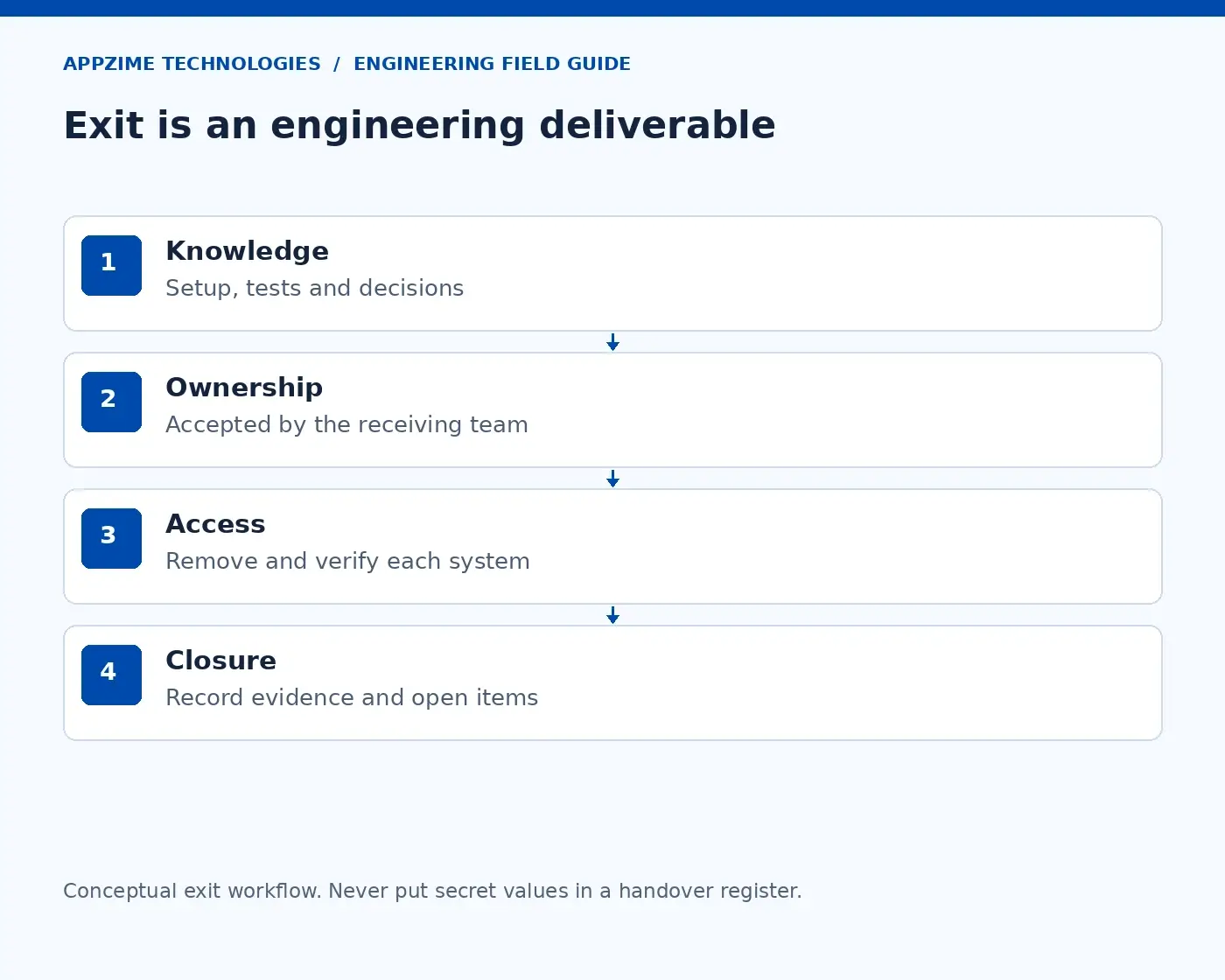
The exit checklist is complete only after ownership is accepted and removal is verified. Keep appropriate evidence under the company’s retention policy. Contractual data-return, deletion and confidentiality obligations should be handled by the authorized business and legal owners.
Measure the process without gaming it
Useful indicators include time to a reproducible environment, time waiting for required access, review turnaround, reopened work caused by unclear acceptance and the completeness of handover demonstrations. Track process causes separately from individual capability.
Raw lines of code, online status and number of messages are weak substitutes for accepted work. A contractor who improves a broken setup guide may create more lasting value than one who produces a large unreviewable change. Agree what evidence matters before the engagement starts.
Frequently asked questions
Should a contractor receive the same onboarding as an employee?
Share the necessary product, engineering and security context. Adapt employment-specific and benefit-related steps to the actual engagement and applicable policy.
When should production access be granted?
When a defined responsibility requires it, with the appropriate approval, scope and monitoring. A start date alone is not a justification.
Who owns delivery when using staff augmentation?
Confirm it in the engagement. The receiving organization usually needs a clear internal acceptance and prioritization owner, even when a partner coordinates staffing.
What if setup takes longer than expected?
Record the blocker and fix the documented path. Revise the plan rather than encouraging a workaround through shared credentials or unapproved data copies.
Can a short engagement skip handover?
No. Scale the handover to the work, but preserve the knowledge and ownership needed to maintain it.
Does this require an expensive onboarding platform?
Not necessarily. A controlled checklist or issue, clear owners and evidence can support a small team. Tooling should follow the operating need.
Make the first deliverable and final handover explicit
AppZime Technologies’ IT staffing page describes engagement options and technical evaluation. Use a scoping conversation to agree responsibilities, location needs, availability, review support and commercial terms. For a broader delivery requirement, review software development services or contact AppZime Technologies with the proposed first workstream.
Current-source note: this guide uses documentation reviewed on 18 October 2026. It does not assert a new six-month onboarding study, measured productivity increase or guaranteed delivery outcome.