IT Staffing | AppZime Technologies

Contract Developer Onboarding: A Practical First-Month Guide

The developer is ready to start. The repository invitation has been sent. Then the first morning disappears into a missing VPN approval, an outdated setup guide, and a question nobody seems to own: “What should I work on first?”

That is the problem contract developer onboarding needs to solve. A new engineer needs enough context, access, and support to make a useful contribution—and enough clarity to know where their responsibility ends.

A good first month gives both sides a workable path: understand the product, get the environment running, complete a reviewed change, and leave the work maintainable. The six checkpoints below follow that path without assuming every engagement needs the same pace or permissions.

1. Agree the first outcome before the start date

A contract tells you that an engagement exists. It rarely tells a developer which part of the application to open on Monday morning. Translate the agreed scope into a short delivery brief.

For this guide, imagine a product team bringing in a backend developer to add a filtered activity-export endpoint. This is a fictional planning example. The internal technical lead owns API design and release approval; the product owner decides whether the feature meets the user need.

The first outcome might be: “An authorised user can export the permitted activity records for a selected date range, using an agreed format and result limit.” That sentence gives the developer something to build and the reviewer something to check.

Now add what is not decided yet. Does the export run immediately or as a background job? Agree how empty results should behave and which dates and time zone apply, so the developer can work from a clear brief.

Give the brief one receiving owner. That person can bring in product, engineering, or security colleagues, but the new developer should not have to discover who can make a decision by messaging half the company.

Keep engagement administration clear as well: working hours, overlap time, equipment arrangements, reporting, and the agreed process for scope or commercial changes. A developer can settle into the work more easily when everyday expectations are explicit.

2. Prepare a usable starting point

The most useful welcome pack is usually a short route through the work, not a folder containing every document the company has ever written. Explain what the product does, which repository matters, and how to get help.

Include the setup instructions, test commands, a simple architecture map, the first-task brief, and the review process. Check that these instructions still work. If they depend on a step only one long-serving engineer knows, write that step down before the new person arrives.

Assign a technical buddy who has time to help. The buddy can explain the codebase and everyday conventions; they should also know when to bring in the person who owns an access or product decision.

GitLab’s remote-onboarding handbook is useful because it treats onboarding as an ongoing process with written guidance and human support. A short contract may need a different timetable, but those two ingredients still matter.

Make the support easy to use. “Ask if you need anything” leaves the newcomer to judge whether a question is important enough. “I’ll walk through setup with you this morning, and we’ll check blockers at 4:00” gives them a dependable opening.
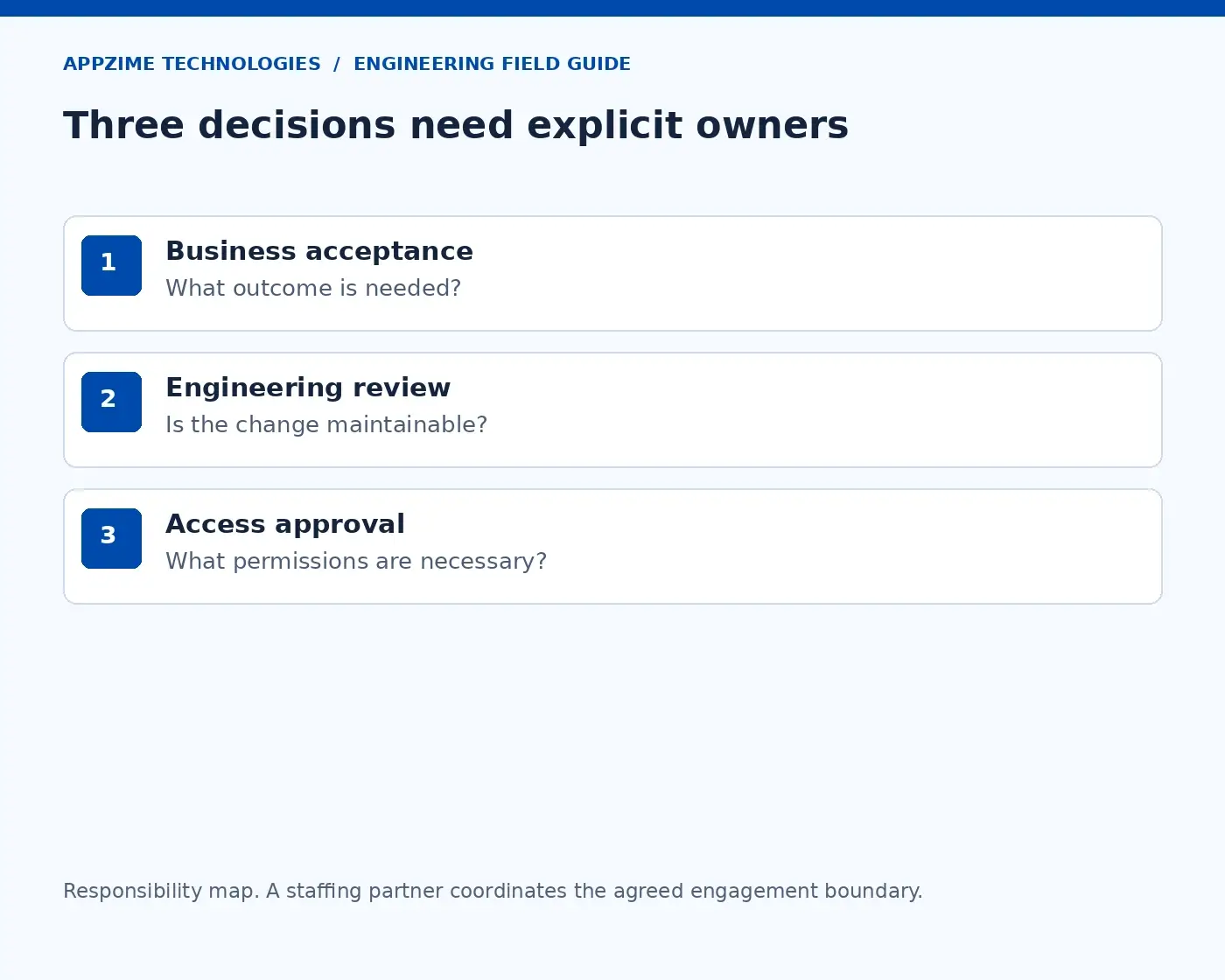
contract developer onboarding: Three decisions need explicit owners. Responsibility map. A staffing partner coordinates the agreed engagement boundary.
Name the people responsible for business acceptance, engineering review, and access decisions. Open full-size visual.

The ownership map separates three decisions: what work is accepted, how code is reviewed, and what access is approved. They can involve the same people in a small team, but they should not become assumptions.

Prepare accounts through the organisation’s usual process before the start where possible. If something is delayed, name the approver and the work that can continue meanwhile. Sharing someone else’s login only moves the problem into a more difficult place.

3. Use the first days to understand the product and prove setup

Start with the user’s journey. For our export feature, explain who needs the file, what they use it for, and which records they may receive. Then show how an API request reaches the relevant services and data.

This is where a short architecture conversation can save confusion later. A developer needs to know which component owns authorisation, where dates are interpreted, and which service already creates similar exports. Otherwise, they may build a technically tidy solution in the wrong place.

Next, have the developer run the documented build and selected tests in the approved environment. Use synthetic data for the initial task. A successful setup means the new person can reproduce the result, not just watch a buddy demonstrate it.

When a step fails, treat that as information about the path. Check for a missing dependency, an incorrect version, or access the guide assumes but the person has not received. Fix the step and update the instructions while the problem is fresh.

Access should follow the task. GitHub’s repository roles distinguish different levels of permission. Someone contributing a feature may need to push a branch and open a pull request without needing administrator control or direct production deployment access.

Keep a simple record of the person, system, role, purpose, approver, and removal owner. Record the access decision, not passwords or token values. This same record will make the end of the engagement easier to manage.

By the end of this checkpoint, the developer should be able to explain the feature in user terms, run the relevant tests, and identify who can answer a product or technical question. Those are practical signs that the first task is ready.

4. Make the first change small enough to learn from

The first pull request is a chance to learn how the team works. Choose a change that exercises the normal development path without handing over a large, poorly defined feature immediately.

For the export example, the first change might cover validation of the date range with focused tests. The developer learns where that logic belongs, how tests run, and what reviewers expect before implementing the rest of the endpoint.

A documentation edit can be helpful, but it may not prove that the application builds or its test suite runs. Choose the first task according to what you want both sides to learn, rather than only how fast it can be merged.

Name a reviewer and a backup before the work starts. Explain where to ask for review and how to flag a blocked change. If the developer waits three days for feedback, record that delay separately from time spent implementing the feature.

Google’s published code-review practices offer a useful starting point for discussing what review should cover. Make the expectations concrete for your repository: behaviour, design, tests, readability, and the documentation needed to maintain the change.

The reviewer should explain the reasons behind local conventions. “We use this helper because it applies workspace permissions consistently” teaches more than an unexplained request to change the code. It also helps the new developer make the next decision independently.
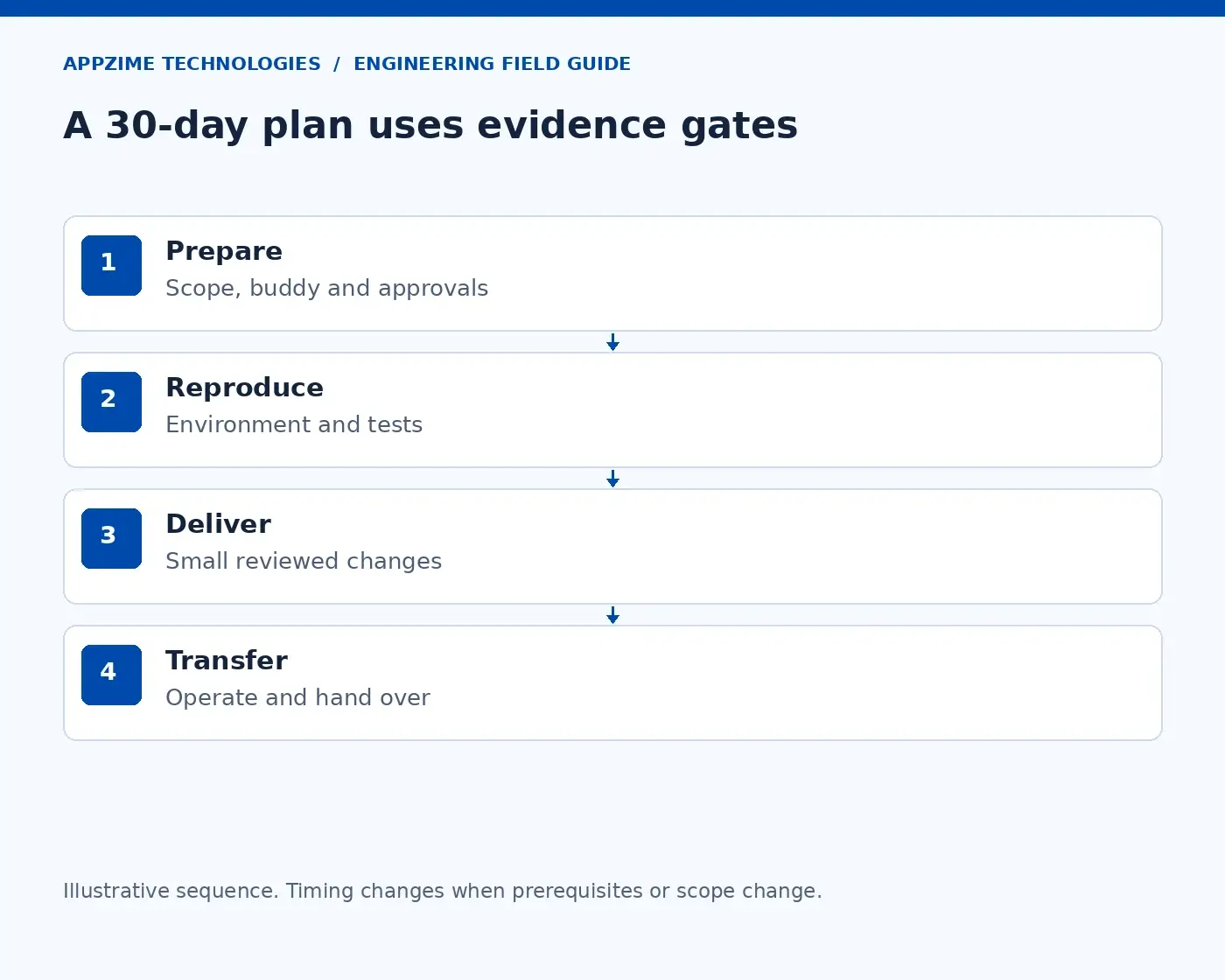
A 30-day plan uses evidence gates. Illustrative sequence. Timing changes when prerequisites or scope change.
Help the developer move from product context and setup to a reviewed, accepted change. Open full-size visual.

The workflow shows why the first merge is only one checkpoint. Context, setup, implementation, review, and acceptance all contribute to a useful result. Rushing one step usually leaves another person to resolve it later.

When the first change is accepted, ask what was unclear or missing. A small correction to the setup guide or review notes can improve the rest of this engagement and the next person’s first week.

5. Build the first month around accepted work

Once the development path works, widen the task carefully. The aim is a sequence of reviewed outcomes, with room to adjust when the team learns something new.

The following plan uses our activity-export example. The dates are planning checkpoints, not a promise that every feature or developer will follow the same timetable.

WhenWhat moves forwardWhat confirms it is ready?
Before joiningScope, access requests, buddy, and reviewerThe receiving owner confirms the starting path
Days 1–3Product context and working environmentThe developer runs the build and agreed tests
Rest of week 1Small first changeTests and review establish the team’s working process
Week 2Export behaviour and implementationPermissions, filters, and output format are agreed and reviewed
Week 3Failure paths and limitsThe team demonstrates agreed behaviour in the test environment
Week 4Release readiness and handoverThe internal owner accepts the change and another engineer can follow its notes

For this feature, the definition of done should include what happens with an empty result, an invalid date range, an unauthorised request, and an export that exceeds the agreed limit. These details are part of the product, not cleanup work after the happy path.

If the result limit reveals that the export needs a background-job design, revisit the scope. That change affects delivery, storage, notifications, and permissions. It deserves a decision rather than an informal expansion of the original task.

Keep check-ins short and useful. Discuss the next accepted outcome, any blocker, the person who can remove it, and the next decision date. The developer should leave knowing what to do next, rather than spending the meeting proving they have been busy.

Plan for the receiving team’s time too. Architecture discussion, code review, QA, and access administration need capacity. A staffing arrangement cannot make those responsibilities disappear.

Deployment access needs separate thought. The developer’s login, the build workflow, and the running application have different purposes. GitHub’s OIDC guidance describes one way workflows can obtain short-lived cloud access through configured trust; the person writing code does not automatically need the same permission.

Review the arrangement as the work changes. A new operational responsibility may justify new access, but the justification should be explicit and approved by the relevant system owner.

6. Make handover part of the work from the beginning

A short engagement can end just as a developer becomes comfortable with the codebase. If the only person who understands the change leaves without a usable handover, the team inherits a new dependency instead of a finished feature.

Keep decisions and operating notes alongside the work as it develops. For our export endpoint, another engineer should be able to find its permission rules, test commands, result limits, known issues, and release or recovery instructions.

Before the final week, ask that engineer to use the notes in a test environment. Can they run the feature, diagnose a failed export, and explain the remaining limitations? This is a better check than asking whether a handover document exists.

Then transfer the unfinished work honestly. List open issues, decisions still needed, and the person accepting ownership. A task does not become complete because the engagement is ending.
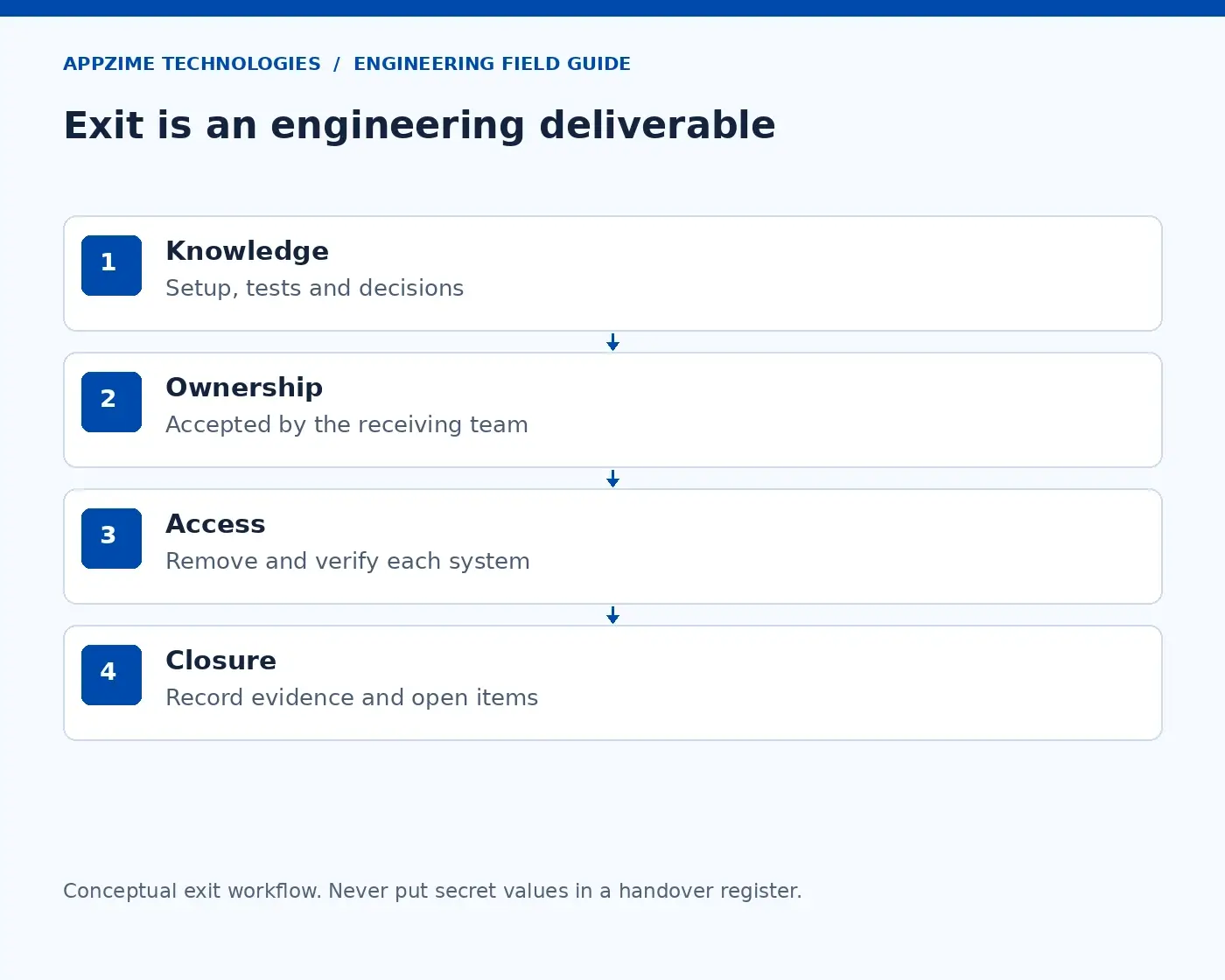
Exit is an engineering deliverable. Conceptual exit workflow. Never put secret values in a handover register.
Leave useful knowledge, an accepted owner, and verified access removal at the end of the engagement. Open full-size visual.

The exit sequence covers knowledge, ownership, and access. Finish all three. A receiving manager should know who maintains the work and which system owners have confirmed access removal.

Review secondary tools as well as source control: package registries, cloud accounts, monitoring, documentation, and integrations. GitHub’s repository-role documentation notes that a person holding a deploy key may retain repository access even after leaving an organisation. Removing membership alone may therefore leave another access path to address.

Have the responsible administrators handle keys, shared secrets, and integration ownership under your normal policies. Keep completion evidence in the engagement record without copying secret values into it.

Notice whether the process is helping the person contribute

Good onboarding should make it easier to identify what is working and what is blocking progress. Track time to a reproducible environment, time waiting for access, review turnaround, and work reopened because acceptance was unclear.

Interpret those numbers with context. A delayed merge could reflect an overloaded reviewer, while repeated changes to the export format could reflect an unsettled requirement. Neither should quietly become a judgment that the new developer is too slow.

You can also ask the developer a simple question at the end of each week: “What do you still need to know to finish the next piece of work?” The answer often points to a smaller and more useful fix than another status meeting.

For a short engagement, scale the process to the work. You may not need a separate onboarding platform, but you still need a clear brief, an available reviewer, appropriate access, and an accepted handover.

Give the engagement a clear beginning and a maintainable end

If you are still deciding how to bring someone into the team, AppZime’s remote-developer hiring guide covers the earlier selection stage. Once a developer is joining, the receiving team’s preparation becomes just as important.

For IT staff augmentation, bring the first-deliverable brief, review capacity, and access requirements into the discussion. If you need a partner to take on a broader workstream, explore the scope through AppZime’s software development services.

You can discuss the engagement with AppZime using two practical questions: what should the developer be able to deliver first, and who should be able to maintain that work afterwards? Clear answers give the new person a fair start and the team something useful to keep.

Sources reviewed on 18 October 2026. The export feature and first-month sequence are illustrative and should be adapted to the engagement.

Data Engineer Assessment: How to Test the Skills Your Team Needs

A candidate can write a neat SQL query and still struggle when yesterday’s numbers change, a job fails halfway through, or finance asks where a total came from. That is the gap a data engineer assessment needs to explore: can this person build data that other people can trust?

You do not need an enormous take-home project to find out. A small, realistic task can lead to a much better conversation—provided you explain the business problem, leave room for questions, and look beyond the final answer.

This guide follows one example from an order feed to a reporting table. Along the way, we’ll look at the SQL, the recovery plan, and the evidence that helps a hiring team make a fair decision.

Start with the job, before you design the test

Before choosing questions, finish this sentence: “The person we hire will be responsible for…” Be specific enough that another engineer could recognise the work.

For example: “Keep the daily orders dataset accurate, including cancellations and late corrections, and help finance investigate differences.” That tells you far more about the assessment you need than a long list of technologies.

A role like this needs careful SQL, an understanding of how records change, and a sensible response when processing fails. A role building a streaming platform needs additional evidence about event timing, state, and replay. One exercise should not pretend to establish both.

Write down the essential skills and the ones someone can learn after joining. If your team uses Airflow, familiarity helps. But a candidate who understands safe retries in another scheduler may be better prepared than someone who knows every Airflow term but cannot explain why a report doubles after a rerun.

There is a useful lesson in Monzo’s published analytics-engineering interview guide. It explains the work first, then describes how candidates can show their reasoning and discuss trade-offs. Analytics engineering is not identical to every data-engineering role, but that connection between the actual job and the assessment is worth applying.

Give the candidate a problem they can understand

Imagine a retailer whose reporting team needs the current value of confirmed orders. The source system sends updates rather than a tidy final table. An order can appear more than once, and its status or amount can change.

This is a fictional assessment example. Use synthetic records and state the rules upfront: keep the highest valid version of each order; count a confirmed order’s latest amount; give a cancelled order a value of zero. All amounts below are in paise, in one currency, for the same business date.

Ask the candidate to produce two things: a current-state orders table with one row per order, and a summary with the order count, confirmed-order count, and total confirmed value. This introduces an important idea without hiding it behind jargon: what does one row represent? Data teams call this the table’s grain.

Share the format, time allowance, and evaluation criteria before the session. A 75-minute discussion could give ten minutes to clarify the brief, 25 to work through the SQL, and the remaining time to explore recovery, checks, and decisions. Treat that as a starting format, and adapt it to the role and the candidate’s access needs.

Also explain whether documentation and AI tools are allowed. If they are, ask the person to explain the result and handle a changed requirement. You are looking for understanding and ownership, not a contest in producing polished code quickly.

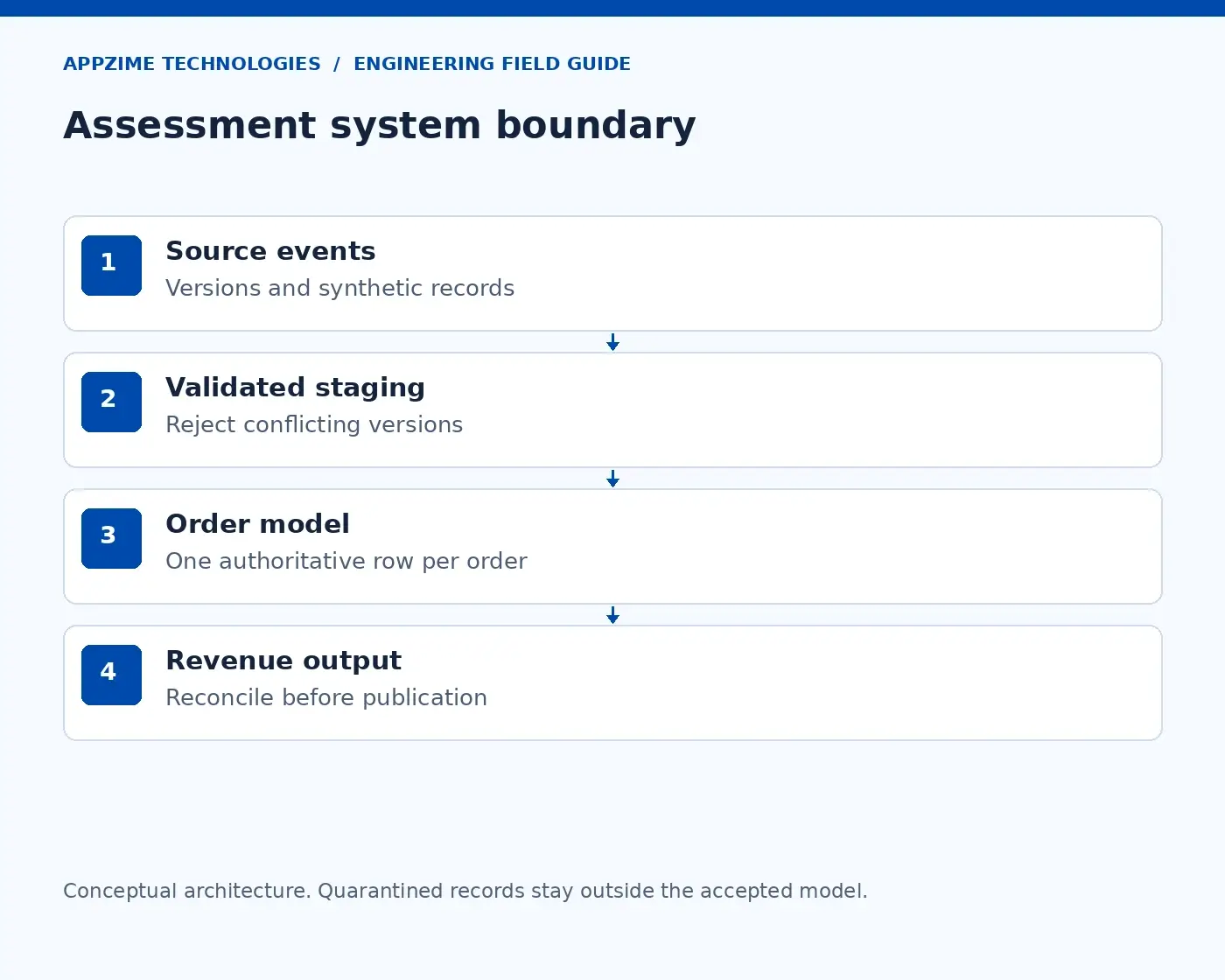
data engineer assessment: Assessment system boundary. Conceptual architecture. Quarantined records stay outside the accepted model.
Follow the records from the source to the published dataset. Set conflicting records aside for investigation. Open full-size visual.

The path in the diagram is deliberately short. Source records arrive, questionable records are set aside for investigation, and accepted records become a useful business dataset. Each step gives you a different part of the candidate’s reasoning to discuss.

Use six records to uncover the important decisions

Here is the complete input. The version number comes from the source and increases whenever that order changes.

OrderVersionStatusAmount in paiseWhat happened?
A1Confirmed10,000Original order
A2Cancelled10,000Later cancellation
B1Confirmed25,000Original order
B1Confirmed25,000Exact duplicate
C1Confirmed7,500Original order
C2Confirmed9,000Corrected amount

The final table should contain three orders. A contributes zero because its latest version is cancelled. B contributes 25,000 paise once, and C contributes its corrected value of 9,000 paise.

The summary is therefore three orders, two confirmed orders, and 34,000 paise—₹340—in confirmed order value. It is a simplified reporting measure, not a complete accounting definition of revenue.

Now ask why a simple sum of confirmed input rows is wrong. It includes A before its cancellation, counts B twice, and includes both amounts for C. The arithmetic is easy; recognising which records belong in the answer is the useful engineering work.

Then ask what happens if an old event arrives after a newer one. Arrival time alone should not overrule the source version in this example. And if two records have the same order and version but different amounts, the rules no longer identify a trustworthy winner: the candidate should raise that conflict rather than quietly pick one.

Read the SQL together, rather than grading it in isolation

Once exact duplicates have been removed and conflicting versions have been handled, a window function can rank the remaining versions for each order. The following PostgreSQL example keeps the latest one and calculates the summary.

-- Input assumption: duplicate/conflict validation is complete.
WITH ranked AS (
  SELECT order_id, event_version, status, amount_paise,
         ROW_NUMBER() OVER (
           PARTITION BY order_id
           ORDER BY event_version DESC
         ) AS version_rank
  FROM validated_distinct_events
)
SELECT COUNT(*) AS order_count,
       COUNT(*) FILTER (WHERE status = 'confirmed') AS confirmed_count,
       COALESCE(SUM(CASE WHEN status = 'confirmed'
                         THEN amount_paise ELSE 0 END), 0) AS confirmed_paise
FROM ranked
WHERE version_rank = 1;

In plain language, PARTITION BY puts each order’s versions together, and ORDER BY puts the newest version first. The outer query counts and sums only the first row in each group. The PostgreSQL window-function tutorial explains this behaviour in more detail.

The query is only one part of the solution. Ask the candidate to walk from each input record to its effect on the final total. Someone who explains why C’s earlier amount disappears has shown more than someone who merely recognises ROW_NUMBER().

Keep the business assumptions visible too. If the next requirement introduces refunds, multiple currencies, or reporting across dates, the brief needs new rules. Recognising that the question has changed is a strength, not an excuse for failing to finish.

Next, make the pipeline fail

The total is correct. Now introduce a realistic interruption: the job writes its result, but the scheduler loses the success message and runs it again. Would the same order value appear twice?

This is where idempotency becomes useful. It means repeating the same operation does not keep changing the intended result. The candidate might propose replacing a defined reporting partition or updating records by a stable key, depending on the storage system.

Airflow’s best-practice guidance makes the same practical point: retries should produce a consistent result, and inputs should refer to a specific slice of data. If a retry reads whatever happens to be “latest,” it may no longer be repeating the same job.

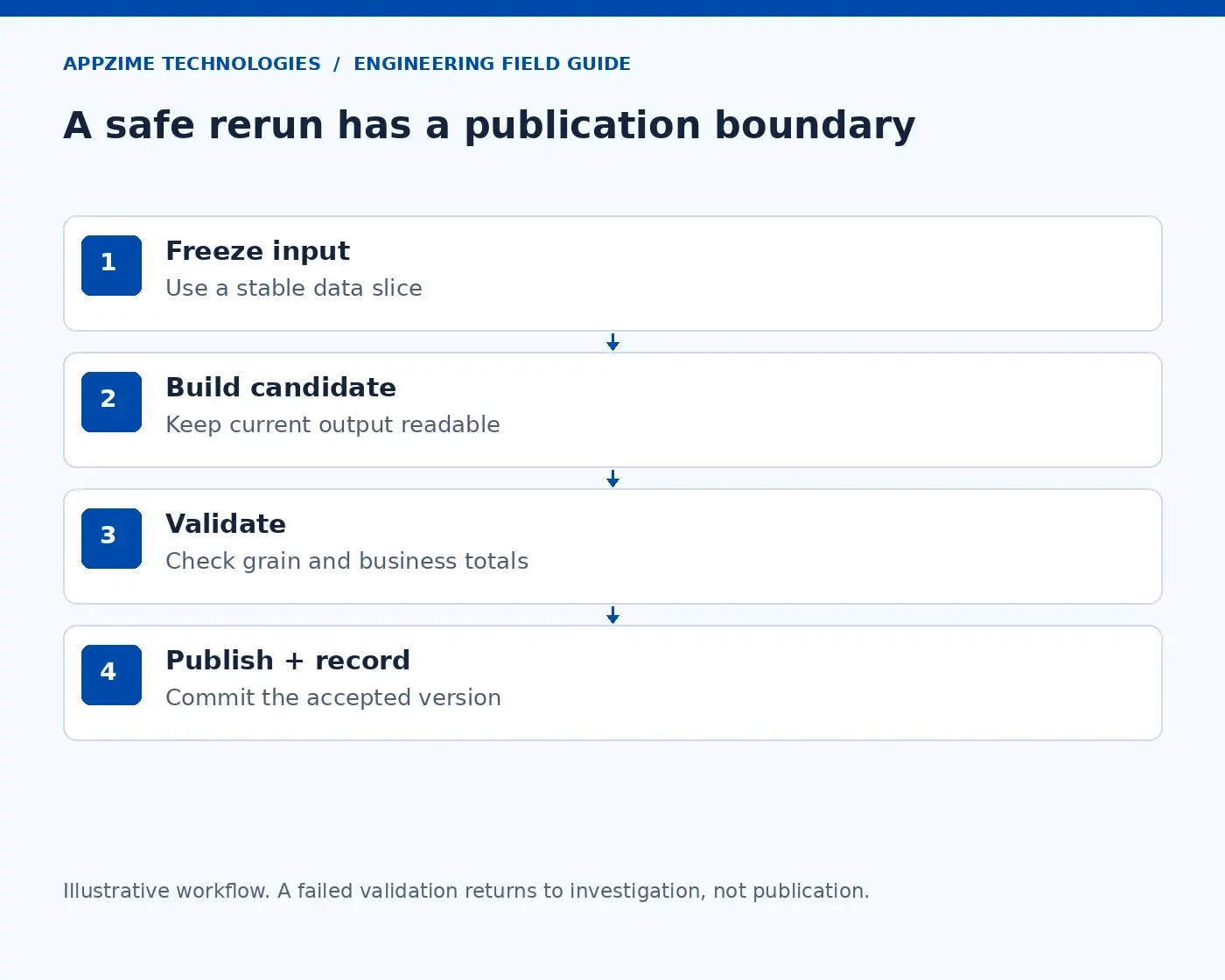
Ask the candidate to describe what readers see while the new output is being built. Ideally, there is a clear boundary between the last accepted result and the next accepted result. A half-written table should not quietly become the finance team’s morning report.

A safe rerun has a publication boundary. Illustrative workflow. A failed validation returns to investigation, not publication.
Build and check a candidate result before publishing it. A retry needs to preserve the agreed output. Open full-size visual.

Use the recovery diagram to slow the conversation down. Ask which input version is being processed, what is checked before publication, and what confirms the result was committed. The implementation can differ, but those questions should have clear answers.

Finally, add a correction for yesterday’s orders. Ask how the team will revisit affected data without accidentally rebuilding unrelated periods or hiding the change from its users. A good answer connects the technical reprocessing plan to the person who relies on the report.

Ask how the team will know when the numbers are wrong

A green job status tells you that code ran. It does not tell you that the numbers make sense. For this example, the candidate should propose checks tied to the promised output.

Useful checks include one row per order, a valid order ID, an allowed status, and agreement between the accepted input and the published summary. Freshness matters as well: a technically correct report that is two days late may still be unusable.

dbt’s data-test documentation describes tests as assertions about data, including uniqueness, missing values, allowed values, and relationships. The hiring question is what the engineer would do when one of those assertions fails.

Would they stop publication, isolate affected records, or alert an owner while allowing the rest through? There is no helpful answer without considering the impact. A conflicting order value and a missing optional comment deserve different treatment.

Ask for the alert message they would send. “Pipeline failed” leaves the next person guessing. “Orders for 17 October were not published because two versions conflict; the previous accepted report is still available” gives the recipient a starting point.

Turn the discussion into a fair hiring decision

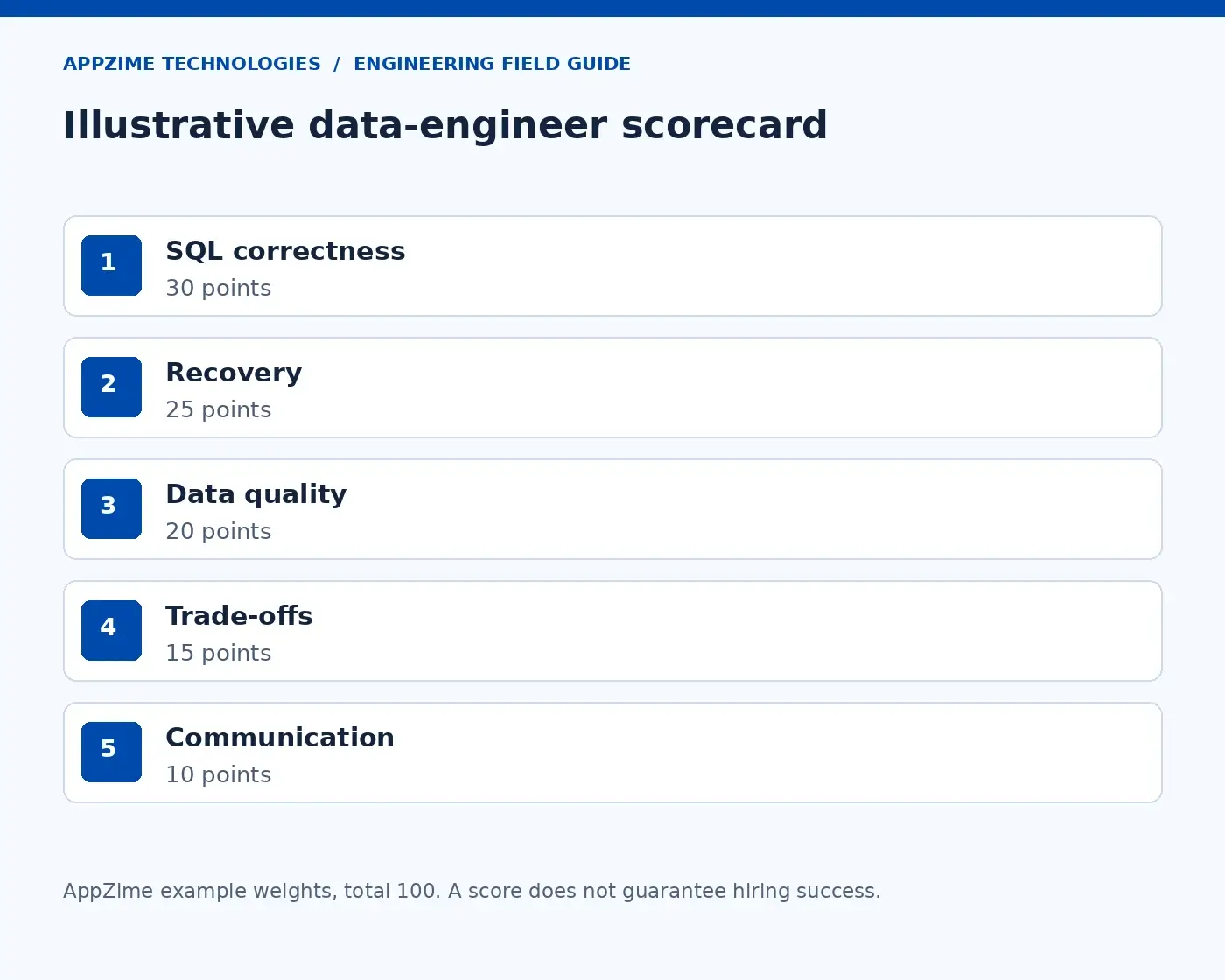
Without shared criteria, interviewers can leave the same session with very different impressions. A scorecard helps them discuss what the candidate demonstrated, especially when one person values quick coding and another values careful questions.

The weights below are an example you can adapt. Score each area from zero to four, then multiply that fraction by its weight; three out of four in a 20-point area gives 15 points. They are a discussion aid, not a hiring-performance benchmark.

AreaExample weightEvidence to record
SQL and data correctness30Explains the current state of every order and gets the agreed total
Reruns and recovery25Explains duplicate prevention and what readers see after a failure
Quality and monitoring20Chooses meaningful checks and names the response owner
Architecture and cost15Chooses a proportionate design and explains its limits
Communication and handover10Makes assumptions and recovery steps understandable
Illustrative data-engineer scorecard. AppZime example weights, total 100. A score does not guarantee hiring success.
Example interview weights, totalling 100 points. Adapt the criteria to the responsibility you are hiring for. Open full-size visual.

Have interviewers write their notes before comparing scores. “Identified the conflicting source versions and proposed an investigation path” is useful evidence. “Seemed senior” is much harder for a hiring panel to evaluate.

Agree the essential requirements before interviewing. A high overall total should not hide a gap in a responsibility the person will own immediately. Equally, do not reject someone for needing a reference page for syntax when their reasoning and result are sound.

Match the result to the responsibility you can offer

A junior engineer may need a clear task and a reviewer. A senior engineer may need to resolve ownership, challenge an unclear data definition, and plan a migration without disrupting consumers. Assess the responsibility you are actually hiring for.

For a contractor, carry the assessment into a first-deliverable brief: reproduce the orders dataset, demonstrate a safe rerun, add an agreed validation, and leave recovery notes another engineer can follow. This gives the engagement a practical starting point.

If you are considering IT staff augmentation, share that brief alongside the job description. If you need a team to own the wider implementation, AppZime’s software development services are a separate scoping conversation.

The next step is small: choose one dataset your business depends on and create a synthetic version of its awkward edge cases. If you need help defining the role around that work, talk to AppZime about the responsibility and expected outcome. That is a more useful place to start than another list of interview questions.

Sources reviewed on 18 October 2026. The dataset, session format, and scoring weights are illustrative.

How to Hire Remote Developers in India 2026: 11 Smart Steps for Global Teams

Hire remote developers in India 2026 is a common search for companies that need engineering capacity without opening a full local office. India offers a large technology talent market across Java, .NET, JavaScript, cloud, DevOps, data engineering, QA, mobile development and AI, but successful remote hiring depends on role clarity, evaluation quality, communication and delivery management.

The goal should not be to find the lowest-cost developer. The goal is to build a reliable team that can work inside your product process, communicate clearly and deliver maintainable software.

Why Companies Hire Remote Developers in India 2026

Remote hiring can give organizations access to specialized skills, flexible team size and extended delivery capacity. It can be useful for product companies, agencies, enterprises and startups that already have leadership but need additional execution bandwidth.

1. Define the Role Before Searching

Write down the expected outcomes, technology stack, seniority, working hours, communication responsibilities and ownership level. A generic requirement like “full-stack developer” produces weak matching.

2. Separate Must-Have Skills From Nice-to-Have Skills

Long skill lists reduce candidate quality because they encourage keyword matching. Focus on the core stack and the problems the developer must solve.

3. Choose the Right Engagement Model

Common models include direct employment, contract staffing, staff augmentation and project-based delivery. The best option depends on how much product ownership and management already exists internally.

Companies that want to add engineers to an existing team can explore AppZime’s IT staffing services.

4. Evaluate Real Engineering Ability

Use practical technical discussions or focused tasks related to the actual role. Avoid puzzle-heavy interviews that do not reflect day-to-day work.

5. Review Communication Skills

Remote engineers need to explain decisions, raise blockers and document work. Communication quality can be as important as raw coding speed.

6. Check Experience With Distributed Teams

Ask how candidates have worked with code reviews, issue trackers, asynchronous communication, release processes and remote stakeholders.

7. Define Time-Zone Overlap

Teams do not need to share every working hour, but they need predictable overlap for stand-ups, design discussions and urgent issues.

8. Set Up Secure Access

Use company-managed accounts, MFA, repository permissions, VPN or zero-trust access where appropriate. Contractors should not receive broader system access than their work requires.

9. Create a Strong Onboarding Plan

Provide architecture documents, development setup, coding standards, product context, deployment processes and named contacts. Good onboarding reduces unproductive weeks.

10. Measure Outcomes Instead of Online Time

Track completed work, quality, review feedback and delivery reliability. Remote engineering should be managed through clear goals, not constant activity monitoring.

11. Build Retention Into the Model

Stable teams usually outperform constantly rotating contractors. Give engineers product context, feedback and meaningful ownership.

Area What to define Why it matters
Role Outcomes and stack Improves candidate matching
Evaluation Realistic technical assessment Tests usable skills
Overlap Shared working hours Improves collaboration
Access Least privilege Reduces security risk
Success Delivery and quality metrics Keeps management objective

Staff Augmentation vs Project Outsourcing

Staff augmentation works well when the client already owns roadmap, architecture and delivery management. Project outsourcing can be better when a partner is expected to own the complete build. AppZime’s broader technology services can support project delivery when businesses need more than individual engineers.

Common Remote Hiring Mistakes

  • Hiring only on hourly rate.
  • Using unclear job descriptions.
  • Skipping technical validation.
  • Ignoring communication ability.
  • Providing weak onboarding.
  • Giving excessive system permissions.
  • Changing priorities without documentation.

FAQ

How fast can a remote developer become productive?

It depends on system complexity and onboarding quality. Clear documentation and accessible technical leadership usually reduce ramp-up time.

Should remote developers work the client’s exact hours?

Not always. Define enough overlap for collaboration while allowing the team to work effectively in its local time zone.

How should companies evaluate remote developers?

Use role-specific technical interviews, practical tasks, code discussions and communication assessment rather than relying only on resumes.

Final Takeaway

If you plan to hire remote developers in India 2026, start with role clarity and a delivery model that fits your organization. Strong evaluation, secure onboarding, predictable communication and outcome-based management matter more than chasing the lowest rate. A well-integrated remote engineer should operate like part of the product team, not like an external ticket processor.

Appzime Logo

Tell us what kind of developer you need

Our AI will analyze your requirements and match you with vetted developers from our global talent pool efficiently and accurately

Upload Job Description

Drag and drop your PDF or DOCX here, or click to browse

Supported formats: PDF, DOCX (Max 10MB)

Takes ~15 seconds · No signup required

AI Neural Matching Engine
Signals extracted: 0

Intelligent Talent Matching

Our AI neural network is processing your requirements across millions of data points

Analyzing job description

Extracting key requirements and technical specifications

Extracting skills and experience

Identifying required technologies, frameworks, and expertise levels

Searching vetted developer profiles

Scanning our global database of pre-screened professionals

Matching candidates with requirements

Applying proprietary algorithm to find best-fit matches

Shortlisting best-fit developers

Ranking and selecting top candidates for your review

Neural Match

Matched Developers

AI-powered matching based on your requirements

AI VERIFIED
4 Candidates Matched
Analyzing requirements...

AI Extracted Requirements

Your Requirements

Need More Candidates?

Unlock full roster with detailed profiles, interview recordings, and salary expectations.

Appzime Logo

Get Instant Candidate Access

Fill in your details to unlock full candidate profiles and connect with top talent.

Detailed JD helps us match better candidates
IT Staffing | AppZime Technologies